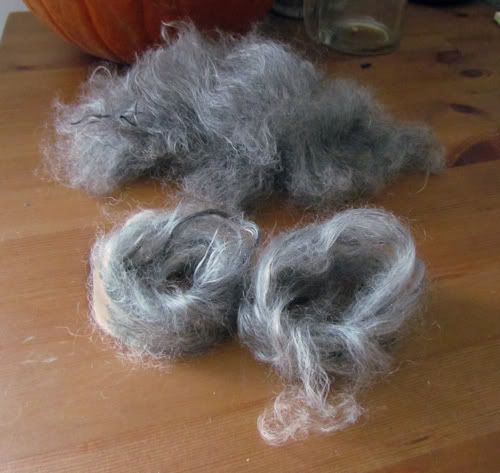
Russian supported spindle

As a little holiday present to myself, I ordered this:
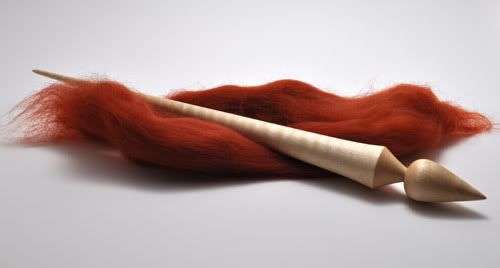
That’s a Russian-style supported spindle, superbly made by hand by Lisa Chan of Gripping Yarn. Supported spindles, unlike drop spindles, rest on a hard surface while spinning. This makes them great for working with delicate fibres and very fine yarns, and can be easier on the hands and arms as well since there’s no ever-growing weight to hold up. It’s a different style of spinning–I’ve spun on a Takhli, which is a supported spindle, but there’s a notch at the top to hold the yarn which makes it more like my drop spindles. Russian spindles, as you can see, have no hook or notch to hold the yarn. One hand drafts the fibre (long draw), and the other both twirls the spindle and holds the yarn in a vertical position so twist can enter it. Youtube has a few decent videos of the technique.

There are a few artisans currently making Russian-style spindles, but I went with Grippingyarn’s after reading the positive reviews on Ravelry. I liked that sustainable woods were an option, and that there’s no polyurethane finish–what you feel is the grain of the wood itself, not a plastic coating. I selected a sustainably-produced curly maple spindle, and within a week Lisa had it turned on the lathe, finished, and mailed off to me. It’s lightweight, smooth, and very balanced. Here’s a look at the pattern in the wood, which catches the light when you turn it:
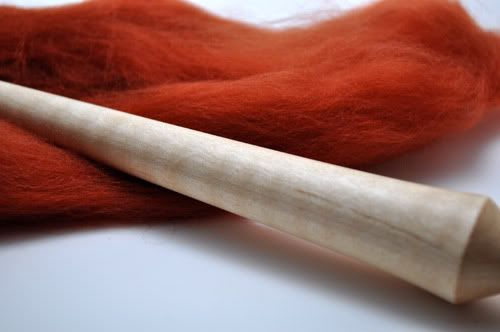
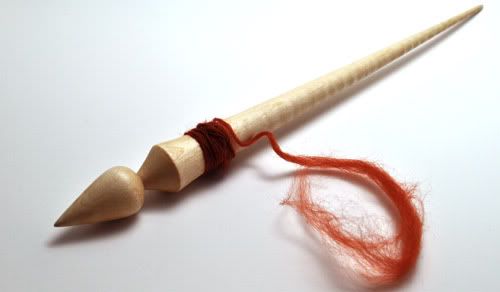
Lisa included a tuft of Merino top, which is the russet fibre in the photos. I had to pre-draft it quite a lot and the spinning was slow going, but next I’ll spin a puni or rolag which is better suited to the long draw style of drafting. I did manage to get the hang of the technique and produce a bit of actual yarn!
It’s hard to find local sources of the shorter down fibres this kind of spindle is meant for–not many cashmere goats in Ontario, so whatever you see in stores is almost certainly Chinese or Mongolian. I did find a yak farm in the Lanark Highlands that will send me some fibre in the spring, so I don’t have to rely on imported sources. I’m hoping to be a little more confident in my technique by then too.

Posted in russian spindle, spindle, Spinning, sustainability | 10 Comments

Citron, finished

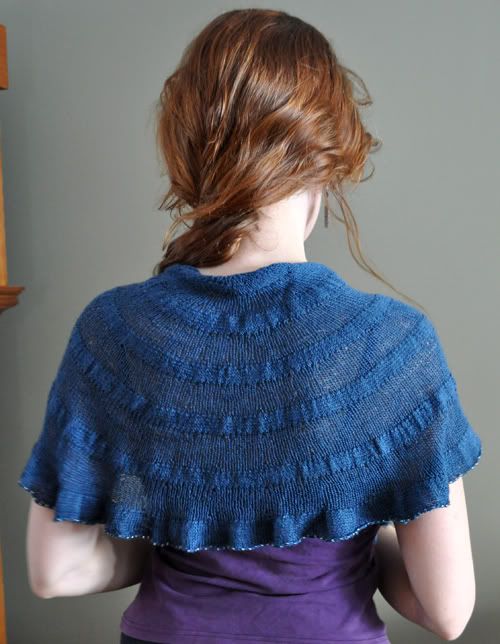
The fact that I last wrote about my Citron scarf in September should tell you a bit about the speed of my knitting. It might also say something about the pattern, which is appealingly simple, but that simplicity also makes for an uninteresting knitting experience. After 500+ stitches in stockinette on the last repeat, a complicated lace pattern suddenly looks very attractive indeed. Still, it’s an elegant scarf and easy to make, if you have the patience.

As I wrote in my previous post, I used Fiddlesticks Exquisite in Sapphire, a 50/50 merino/silk laceweight. It’s a smooth yarn and easy to work with. It’s also extremely warm–I was quite comfortable in the photos below even though it was a chilly day, even indoors:

I like wearing it as a small scarf rather than a shawl, but here you can see the orange-slice effect that gives it its name:

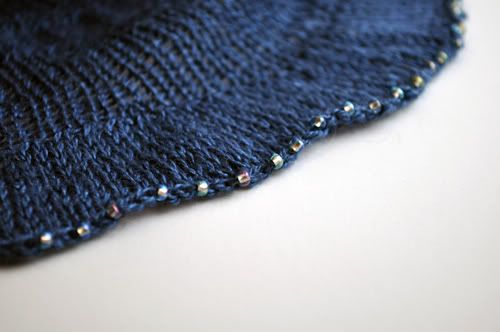
I really enjoyed the beaded bind-off, with 8/0 glass seed beads on every other stitch. I used Splityarn’s tutorial, and discovered very quickly that I needed to bind off much more loosely than usual. I’ll probably use this technique again (I certainly have enough beads left over…).

Posted in finished object, Knitting | 9 Comments

I went to Montreal on Saturday, filled with plans for the day that almost all fell through. Fortunately Montreal is the kind of city where you can always find something interesting to occupy your time, and it wasn’t long before I was visiting a few favourite places, including Ariadne Knits.

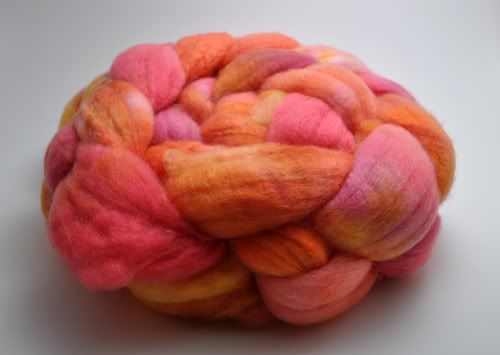
It’s not often that I spin Merino wool. For a long time the commercial spinning fibre market has been saturated with the stuff (of widely varying quality to boot), leading me to largely ignore it after my earliest spinning efforts in 2005. I did buy a braid of it in 2007, the same braid that became my Focused and Distracted skeins this fall. Picking up again at the harvest festival in Dunvegan, I found I really enjoyed the soft, almost spongy drafting after a long period of spinning low-crimp fibres. At Ariadne this weekend, I resolved to pick up a braid of the store’s hand-dyed merino. With the cold, dark, slushy weather outside, I was drawn to the yellows of the Impatiens colourway:

Yellow! I’ve never liked it, but I think my colour preferences are changing. I’m going to spin it on my Bosworth spindle, I think.

Posted in Spinning, travel, yarn stores | Leave a comment

Your Yarns submission

Every issue (perhaps less often, now that I think about it), Spin-Off invites readers to spin and submit their own yarns according to a set theme. The theme for the next issue is camelids, so I spun up a lock each of the two fleeces I bought from Laurentian Alpacas this year. It remains to be seen if my sample makes it into the magazine, but I like the effect of the two colours plied together:

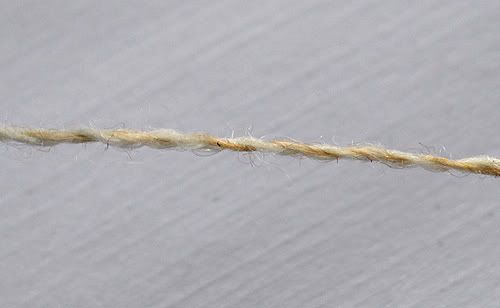
This is actually about a sport weight, probably finer, and extremely soft. So close up it looks like rope, doesn’t it?

Posted in alpaca, spindle | 1 Comment

“Selfish” Knitting


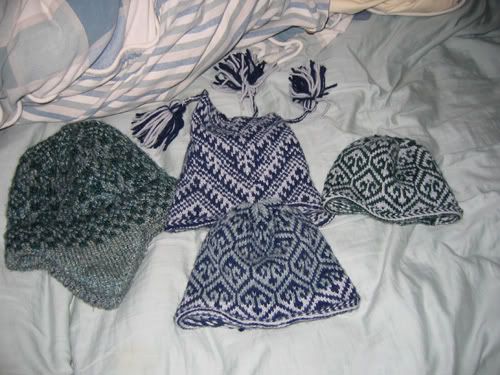
Early hat efforts, circa 2005

Around this time of year, it’s not surprising to see many people rushing to finish hand-knit gifts for the holidays. I’ve also seen a few people refer to their chance to get some “selfish knitting” done come January, and I find this an interesting choice of words. Google it and you get quite a few blog posts about knitting an item for oneself, as opposed to knitting for someone else. It’s a loaded phrase, one that reveals the expectation that knitting is something to be done for other people, and to do otherwise is somehow negative. I think most of us who knit have been asked at least once about a project, “And who is it for?”

It occurred me to that I’ve never heard the phrase “selfish painting” or “selfish art” (and the paucity of hits on Google for these terms backs up my experience). How often does a painter get asked, “And who are you painting that for?” I can’t imagine a musician being admonished for writing a song they intend to perform themselves. And yet craft, knitting in particular, is often seen as selfish if not done for the benefit of others. Is this because craft, unlike art, is meant to create a functional item, rather than one that exists for its own sake? Is it because we tend to associate knitting with caregivers, our mothers, grandmothers, and aunts?

The other day I was looking through photos of knit items I’ve made over the past several years. From early 2005 to about 2007, I really didn’t knit anything for myself. Everything was a gift for someone else, or made for a charitable cause. I liked knitting for other people, and it was nice to be able to present friends with a hand-made present to commemorate a special occasion such as a wedding or birth. It could be hard to part with some items, I’ll admit, and there were one or two occasions where it was clear that the recipient either didn’t realize, or didn’t care about, the weeks or months of work that go into making even a relatively simple item. Soon my friends were getting married and having kids faster than I could keep up with hand-crafted presents, and the transition from school to full-time work meant I had much less time for knitting. These days, I’ve mostly given up gift knitting, though I still like to work on some charitable projects. I knit for myself, but I’d never call it “selfish.”

So tell me, knitters–is knitting for oneself “selfish”? Do you think the concept applies to knitting and craft more than the fine arts? Do you knit mostly for yourself, or for others?

Posted in Knitting, Uncategorized | 3 Comments

Pima cotton, spun up

Having experimented with cotton solely on a Takhli spindle, I decided to try it out on a wheel. I chose the SuPima sliver from my All About Cotton Kit because it has a relatively long staple length and is therefore less likely to fly apart into tangly bits when the wheel gets going fast. Irene at Cotton Clouds had recommended sitting far back from the wheel and using a long draw, which I tried, as well as a short worsted draw. Ultimately a kind of point-of-contact drafting style seemed to work best, even sitting rather close. I’ve carded a few punis and will try them next; I imagine they will work better long draw.

Edited to add, based on a comment: I spun this on my Lendrum folding wheel, using the fast flyer at a 12:1 ratio. I tried at 17:1 but it was too fast–the spinning went much easier at a slightly slower ratio.

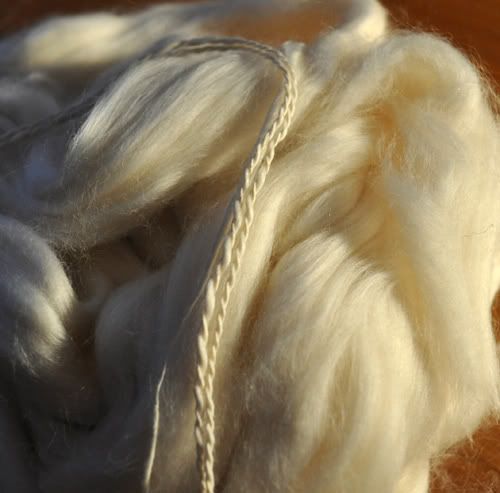
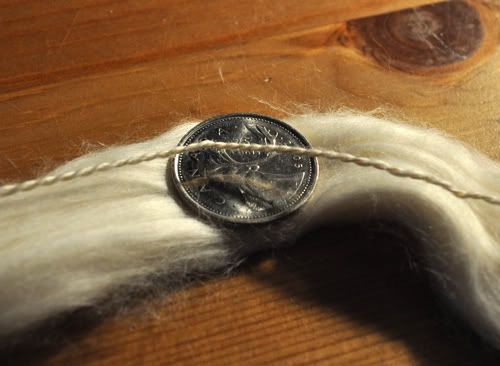
The finished yarn reminds me of kite string. It would make nice weaving yarn (or perhaps I say that because I don’t care for knitting with cotton).

With a quarter for size comparison:

Posted in cotton, Spinning | 4 Comments

More Stansborough: experiment with combing oil

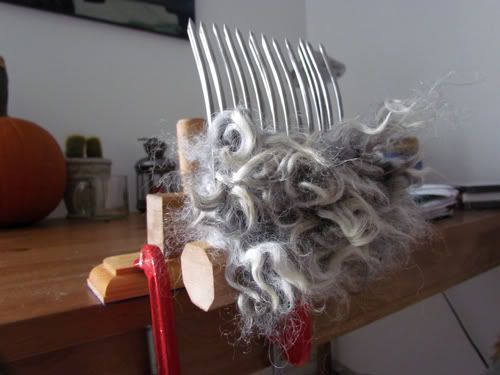
Despite an incredibly busy schedule the last couple of weeks, I did get in another round of combing of the Stansborough Grey. I decided to try combing with oil, especially with the radiator heat drying out the air and causing static of epic proportions. I used my usual recipe, albeit a little heavier on the water this time. Loaded up with locks:

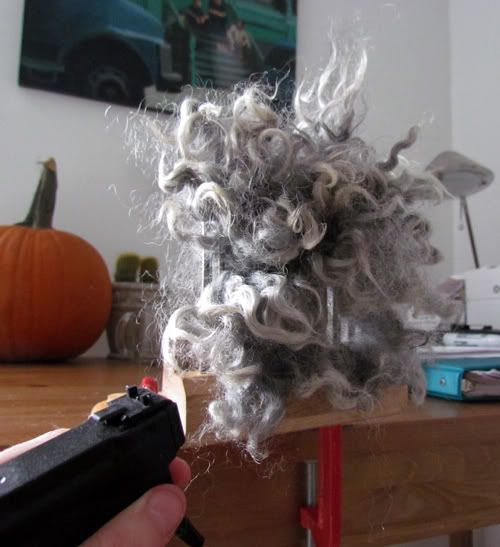
I then fluffed apart the locks to get a more even distribution of the combing solution, otherwise you risk coating the other layer while the inner section stays completely dry.

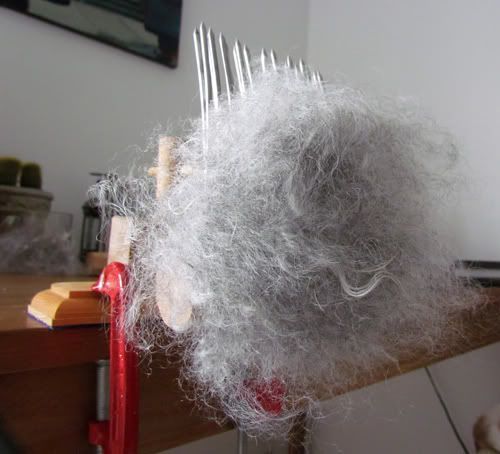
Still pretty fluffy after one pass, so I responded with more sprays. I think I overdid it, as I’ll get to later:

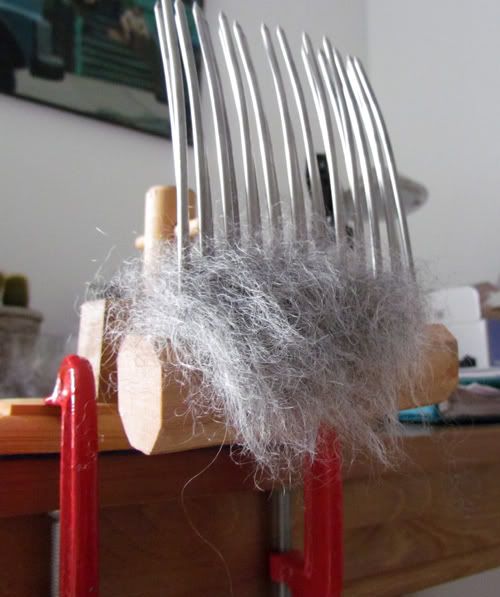
After each pass I collected the shorter waste fibres:

In the end, after three passes, I had a couple of tight, dense birds’ nests of top and a neat pile of waste:

I got a little oil-happy and overdid the spraying between each pass. Pulling the top off through the diz was hard and the fibres did not want to slip past each other. They were way too loose and slippy without oil, so I know there’s a happy medium here. Next time I’ll use less combing oil, especially on the last pass. I’m looking forward to finally spinning this stuff!

Posted in combing, combing oil, Spinning, stansborough grey | 3 Comments