First real sewing project

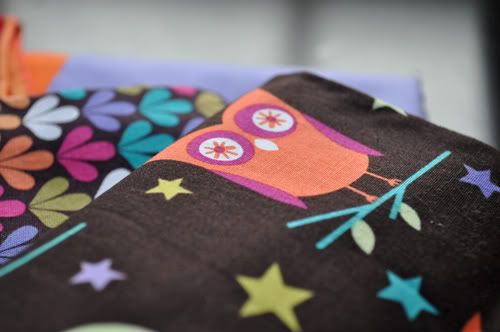
Outside of one made in a class, I mean. Why I decided on one that requires me to match nine different fabrics, I can’t say, other than I thought the Zig Zag quilt pattern looked very cute and within my very novice ability. Except for the edging, which will surely require another trip to Emeline & Annabelle some Sunday (oh no!).

The thing about sewing, as with most other fabric/textile/fibre endeavours, is that it is neither more cost-effective nor more efficient than buying a finished product. It does of course bring those satisfying feelings that come with creating something by hand. As I try to use sustainable materials as much as possible in my work, sewing presents a problem: sustainably-produced textiles are both hard to find and very expensive, and the labour involved in making my own (spinning and weaving from raw materials) is currently prohibitive, time-wise. So, I’m working with conventional fabrics for now…

Posted in sewing | 5 Comments

Stansborough Grey, first combing

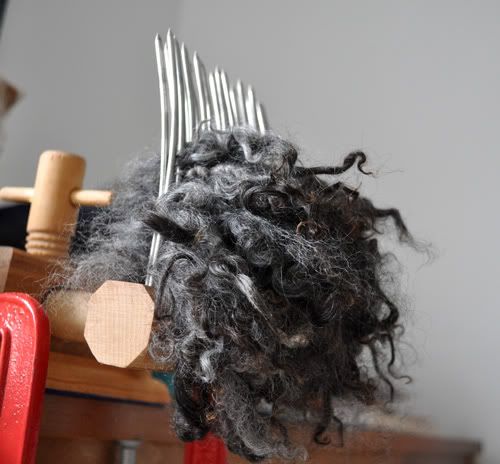
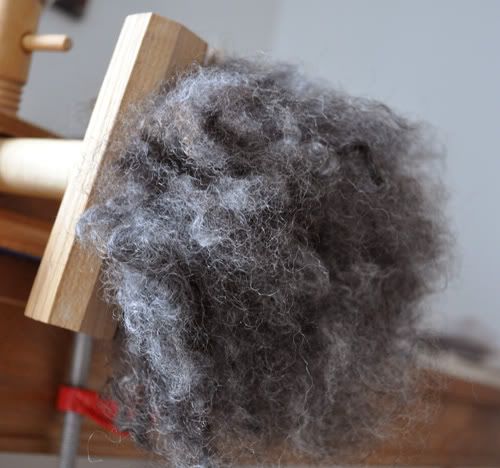
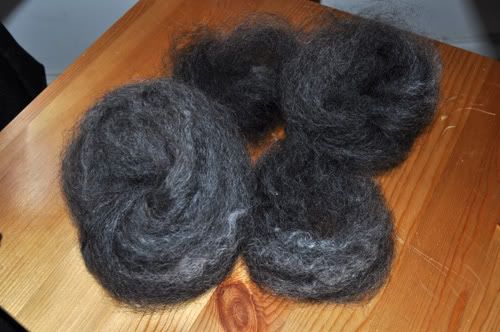
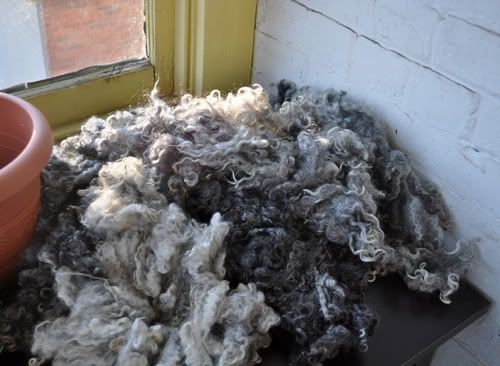
That’s my first combful of the Stansborough, in the dark grey colour. For experimenting I probably should’ve used the mid grey, since that’s what I have the most of, but that would’ve required careful planning. I decided on two passes, to minimize waste–I want a smooth worsted yarn, but I also want to have enough for weaving, which takes lots of yardage. After a single pass, it looked like this:

Still a lot of lock definition, which mostly disappeared after pass number two. I say mostly, because you can see what I discovered when I started to pull off the top through the diz:

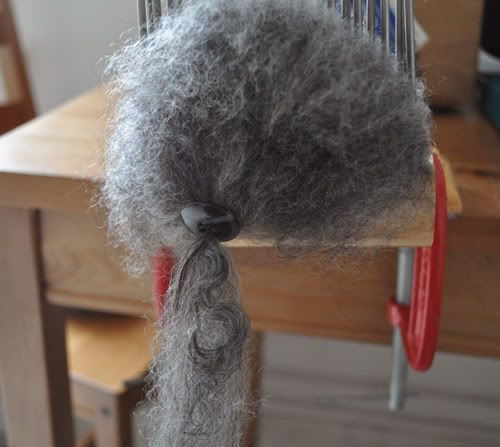
Yes, a few locks had escaped me. This, along with the fact that I found there were a whole lot of shorter fibres left on the comb after I had pulled off most of the top, convinced me that this is a three-pass kind of fleece. Yes, it will mean more waste, but my top will be more consistent (since I won’t end up with nothing but short fibres at the end), and I can card the combing waste to use as a woollen yarn for the weft. Here’s the little birds’ nests of top, ready for spinning:

This wool is really, really soft. Also very slippery. I’m almost inclined to use combing oil but that of course necessitates another step (washing the finished yarn to remove the oil, lest it go rancid). I’ll see how much static I have to contend with after three passes.

Posted in Spinning, stansborough grey | 11 Comments

Sewing at Emeline & Annabelle

Two years ago, when I was too busy to blog, I took my first sewing class at Spool in Philadelphia. I loved it, feeling rather proud and making good use of my first project, a reversible tote bag. Really I should say it was my first machine sewing class, as I learned the basics of handsewing when I was about 7. My mother let me play around with scraps of fabric (I made a lot of badly-fitting cardigans for my stuffed animals) while she sewed with her friends. I also took a hand quilting class one Wintersession at Wellesley, when several non-credit “fun” classes are offered to students marooned on campus during the long January break.

As much as I liked the class at Spool, life subsequently got busy and complicated and I didn’t touch a machine again. Well, until yesterday.

Not long ago, Emeline & Annabelle opened in Montreal’s NDG neighbourhood, and two of my friends soon raved about their classes. Sewing classes are hard to come by in Ottawa, at least ones that aren’t expensive and require you to bring your own machine. So with a reminder that I had several vacation days to use up, and a good sale at VIA Rail, I signed up for a private Sewing Basics course to refresh my skills. I had high expectations and was not disappointed.

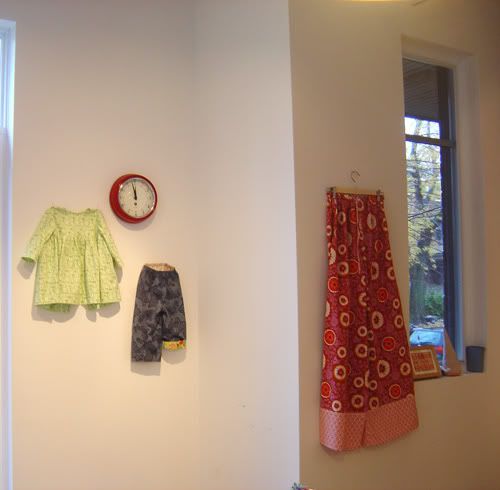
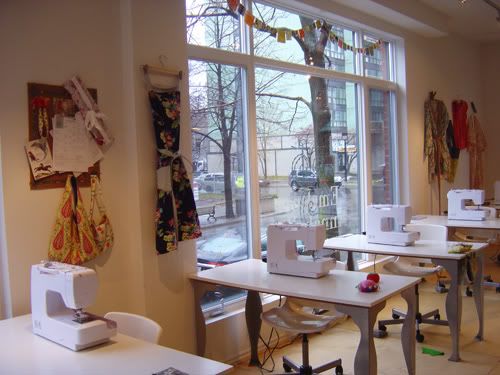
From the moment I walked in, both Emeline and Annabelle were warm and inviting and easy to learn from. It’s a lovely space with lots of room and light, as well as comfy chairs to sit and have an espresso. Most of the course involved skills I’d already learned (although threading the machine would’ve been impossible without repeat instruction), but Emeline also gave me some new tips like encasing seams in zigzag stitch if you don’t have a serger.

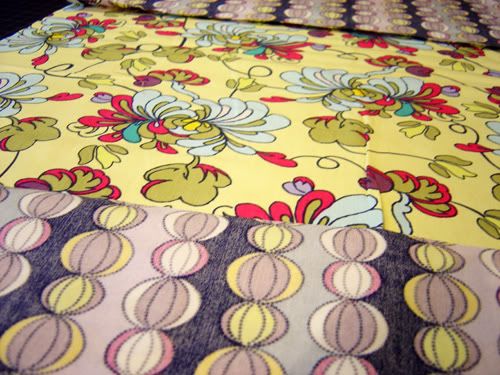
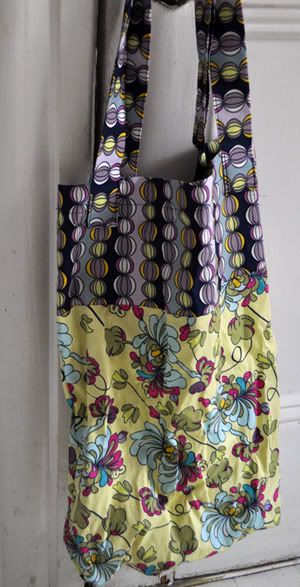
I was, shall we say, a little indecisive about what fabric I wanted to use for my project (another tote bag). Emeline advised me to rule out the colours I didn’t want. “No yellow,” I immediately replied. Then I saw the purple and yellow fabric with a design that reminded me of diatoms, and…

I approached pinning and cutting with scientific precision, as if I were plating microbes or titrating a solution that could explode if allowed to run too quickly. “You’re very meticulous,” said Emeline, as I took at least five minutes to cut a square. I did get a little cavalier with the actual sewing, in my enthusiasm to race through a long line of straight stitch, and so there is a seam or two that is more decorative than functional. Just don’t look too closely, and it’s quite a pretty bag:

I can’t wait to go back. Just about every class offering looks fun, and I may go back to rent a machine by the hour (until I get my own) to get a heap of quilt blocks pieced. Not a bad way to spend a dreary fall day!

Posted in sewing, travel | 4 Comments

Stansborough Grey, again

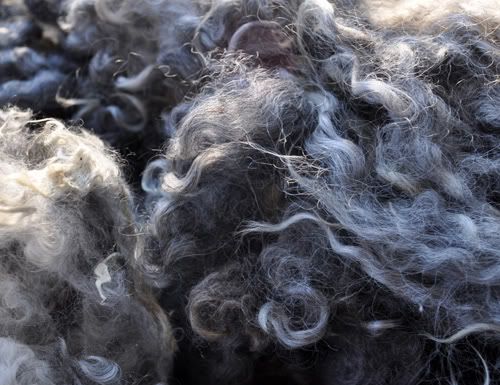
Given that I just taught a course on fibre prep, I figured I ought to do a little prep of my own with the Stansborough Grey fleece I bought recently from International Fleeces. I actually bought a bit more (well, a lot more) when it came on sale a few weeks ago, and stocked up on the light and dark grey varieties as well. (And in case those of you who took my Fibre Prep class were wondering why I was so eager to have you take the rest of that white fleece off my hands, this is the reason.) As a fleece, it really has very little lanolin, which came out easily in hot water and Unicorn Power Scour. The pictures, again, don’t do the lustre any justice:

I’ll comb and spin the three colours separately. I haven’t picked a project yet but I want to spin it fine enough for weaving, and with winter (and radiator heating) coming on I imagine I’ll be using some combing oil to counteract the static.

I can’t wait to start working with it!

Posted in Spinning, stansborough grey | 2 Comments

Fibre Prep at Wabi-Sabi

To say this fall is busy would be an understatement, and I looked on my upcoming classes (scheduled this summer, when my datebook had a lot more blank lines in it) with some apprehension. Working full time and taking two course, along with a couple of evenings of volunteer work, does not a relaxing schedule make.

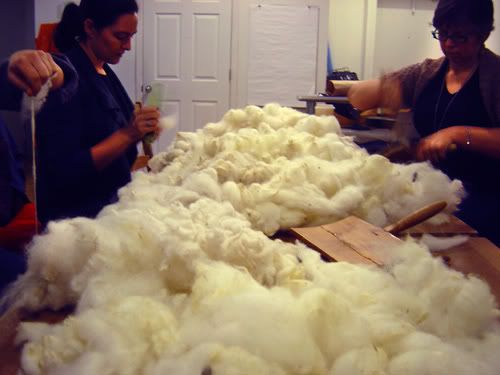
Once I actually got to the classes, though, I was glad to be back teaching them. I love seeing people’s faces when they “get” it and they go from unsure to enthusiastic. The biggest compliment, I think, is having students come back for more of my classes. Out of six students for Fibre Prep this Saturday, four had taken one or both of my other classes. It’s great to see familiar faces as well as find out how their skills have grown. The class was a good group this week–everyone very excited to learn about working with raw wool, and with a great sense of humour. One student even bought handcards from the shop in the middle of class! Success.

Posted in Spinning, teaching | 4 Comments

FO of yore: ChildHood cardigan

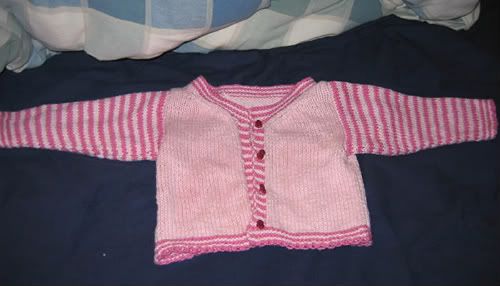
As I mentioned before, my first (well, only) handknit sweater was for a small child. A few years ago, before I started this blog, I made the ChildHood cardigan from Knitty for the daughter of friends, using cotton yarn for a project for the first time. Making it taught me a few things:

1) Parents really like receiving hand-knit items for their kids when they’re past the infant stage (birth being the usual occasion for the gifting of hand-knits);
2) Ripping back a whole sleeve is not so bad when it is sized for a two-year-old;
3) Wool is a lot more forgiving than cotton;
4) Seaming isn’t bad, but weaving in ends is.

It’s crazy to think that at the time, I knew hardly any people with small children. Now it seems like most of my friends are having kids, and faster than I can keep up with. Seriously guys, slow it down. I can’t knit that fast!

ChildHood is a fairly easy pattern and good for novice sweater knitters. I used Bernat Cottontots yarn, the recommended Mission Falls yarn being discontinued at the time. The buttons are monkeys as the recipient had a lot of monkey-themed stuff already, but they are decorative only–the sweater fastens with snaps underneath.

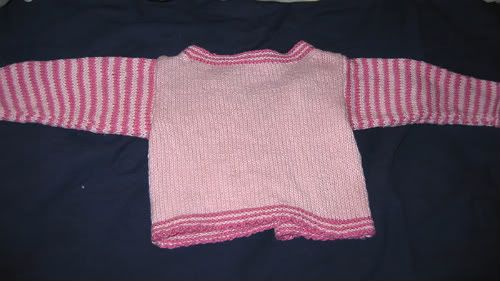
Shot of the back:

So, I hereby commit to knitting Gwendolyn. (I considered Pas de Valse too, but I’d rather not make a pattern that uses such fine yarn, which equals many more thousands of stitches).

Posted in finished object, Knitting | 1 Comment

Cotton

In my five-plus years of spinning, I’ve never worked with cotton. Dissuaded by other people who called it a difficult fibre (and my own dislike of the feeling of the cotton stuffed in pill bottles–such a dislike turns out to have its own name, haptodysphoria), I always avoided it and instead stuck to animal fibres. Then I got an email about a writing assignment and without revealing too much just yet, I’ll say that I suddenly had to learn a lot about this fibre that has shaped history.

No one knows exactly when humans first began to cultivate cotton, a plant whose hairy-coated seeds could be carried by the wind and therefore dispersed a greater distance. The earliest cotton growers, possibly in the Indus Valley, selected for plants with increasingly long and fine seed coats that could be spun into thread and woven. Cotton harvests around the world can make or break national economies, and its production has led to previously unknown luxuries as well as astonishing cruelty (its history in the American South being one of the more well-known examples of the latter). As an agricultural product, it is exceptionally vulnerable to pests and requires more pesticides than any other crop. It is ubiquitous: clothing, tires, home furnishings, medical supplies, bookbindings, and fertilizer all can claim cotton as a base material. It rivals wool in its importance to civilization.

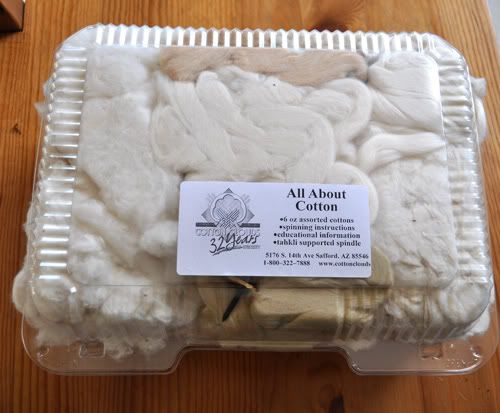
Soon after finishing my research, I received a package from Cotton Clouds, a large retailer of cotton yarns and fibre in Arizona. Irene Schmoller, the owner, had sent me samples of all the cotton she carries and an amazing cotton spinning kit (and a generous handful of coffee caramels–thanks, Irene!). Cotton, like wool, comes in several different preparations. The sample card had sliver (combed and carded), top, raw cotton, and a small puni:
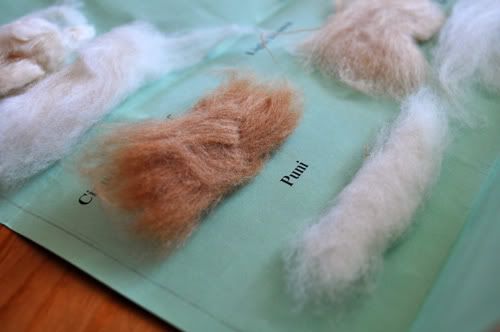
Those are all natural colours, by the way. Cotton is usually white or cream but green and brown strains also exist. I touched the samples a little hesitantly, but the feel was entirely different than the vitamin-bottle variety. SuPima, the longest and finest type of cotton (think high-end dress shirts or bedsheets), feels almost like silk. The kit contains a few types of sliver and quite a lot of raw cotton, which I’ll eventually make punis out of with my cotton cards, which up until this point have been reserved for alpaca and fine wool.
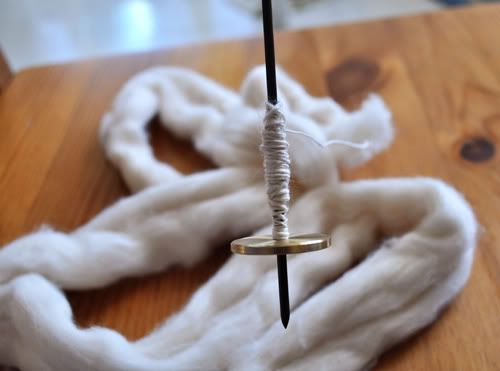
The real test was in the spinning. The kit included a Tahkli spindle from India, which is a small supported spindle with a heavy brass whorl for building up lots of twist. Spinning cotton longdraw isn’t actually all that difficult, though I suspect my previous experience with wool helped. It does require a lot of twist–even after the yarn is formed, you must add more twist before winding on. My first attempts are lacking in consistency but as I tell my students, don’t expect perfection on your first go at it.
Six ounces of cotton is a surprisingly large volume, and I’m looking forward to experimenting more with the various preparations. More posts to come, for sure.

Posted in cotton, Spinning, writing | 3 Comments