Skein competition how-to, Part 2.5: How to make a niddy noddy

One of the most important parts of a skein competition is presentation, which largely entails winding it to a certain circumference and tying it properly. I’ll go over this in detail in my next post, but for this extra entry I’d like to emphasize the importance of a niddy noddy in the process.
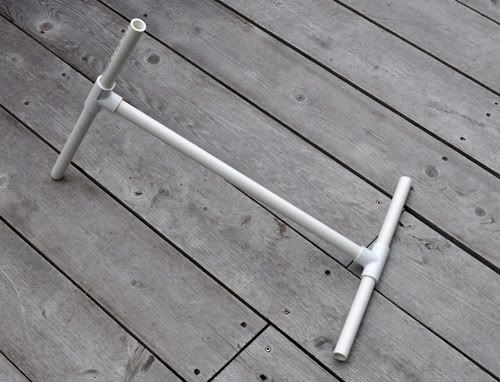
A niddy noddy is a device for winding yarn into a skein, consisting of a central bar and two crossbars offset by 90 degrees. As for where such a silly name came from, I’m guessing Middle English is to blame but as both American Heritage and Merriam Webster failed me on the etymology, I’ll have to post the answer to that when I next get access to the OED. Anyway, if you’re not familiar with how to wind yarn on a niddy noddy, I’ll go over that tomorrow, but know that you can use one to determine the circumference of your skein as well as measure the length of the entire thing–again, more on that in my next post.

There are lots of lovely handmade wooden niddy noddies out there, but I like my DIY PVC version for four reasons:

1) It’s cheap
2) You can block a wet skein or hand paint yarn on it without damaging it (unlike wood)
3) You can change the circumference of the skein by using central bars of different lengths (see below)
4) It’s portable (disassemble and go)

I can’t claim ownership of the PVC design, and don’t even remember where on the web I found the instructions several years ago, but here’s how to make one. You’ll need 1/2″ PVC pipe and 2 T-joins (to fit 1/2″ diameter), seen below:

Home Depot, Lowe’s, and the like often sell PVC pipe in lengths of about 5 feet. Have the sales staff cut the pipe into four pieces measuring 6″ (for the arms of the crossbars) and one or more longer pieces for the central bar. The length of the central bar should be 1/4 of the desired skein circumference (or just a bit less, as the T-joins add an inch or two). So, if the competition calls for a 2-yard skein, the central bar should be half a yard, or 18″. A 1-yard skein requires a central bar of 9″, and so on. Here’s an 18″ bar with one of the 6″ arms:

The pipe and T-joins usually don’t run more than about $3-4, and for that you’ve got a very useful tool to add to your spinning collection.

Posted in competition, diy, skein competition how-to | 1 Comment

Skein competition how-to, Part 2: Basic requirements

The basic requirements for competition skeins vary depending on the class or category and the competition itself. Generally, there are categories based on any or all of the following characteristics:

– Fiber content. Different classes usually exist for 100% wool, plant fibers, blends, etc.
– Number of plies. Singles, two-ply, multiple-ply, etc.
– Natural color or dyed fiber.
– Preparation (i.e., was the fiber prepared 100% by the spinner, or was it commercially prepared in any way?)
– Spindle- or wheel-spun. Sometimes there are classes specifically for yarn spun on a drop spindle.
– Diameter/WPI. Yarns may be divided up into fine, medium, or bulky/thick. Sometimes this is done based on wraps per inch, or WPI. To find out that the WPI of your yarn, wrap it around a ruler several times being careful not to pull it too tight (which will stretch the yarn and make it narrower) or push the wraps too close together — they should be just touching. Count the number of wraps over 1 inch and you’ve got your WPI:

The yarn above measures at about 8 wraps per inch.

In addition, there are often eligibility requirements that you should be aware of. These may include:

– When the skein was spun. Some competitions only allow skeins that have been made in the past year.
– Age/level of the spinner. Be aware of different divisions for youth versus adults, or novice spinners versus professionals.
– Length of the skein. There is usually a minimum length for the skein, measured in yards, and finer yarns often don’t need to be as long as medium or thick yarns.
– Weight of the skein. Similar to the length requirement, with finer yarns usually accepted in smaller amounts. If you’re not sure how much your finished skein weighs, especially if some of your original fiber didn’t survive the spinning process, put the skein on a kitchen scale– it’s accurate enough for the weight requirements for competition:

Just over 2 ounces for this skein.

Let’s look at the requirements for a couple upcoming skein competitions this year, cut and pasted from the festival sites:

Great Basin Fiber Arts Fair

Main categories are wool, non-wool protein, plant, novelty.
· Further divisions may include separate classes for alpaca, llama, angora,
silk, linen, soy, etc.

· In addition, each group may be divided by weight: Fine (20 or more wpi),
Medium (10-19 wpi), Bulky (less than 10 wpi).
· Other divisions may be number of plies or other specific techniques used.
· Fine grist skeins (20 or more wpi) must be a minimum of 40 yards in
length. All of skeins shall be a minimum of 2 ounces
. Under-weight or
under-length skeins will be disqualified.

Finger Lakes Fiber Arts Festival

Category 1: Wool and all other animal fibers except silk. Includes 100% any one animal fiber and animal fiber blends.
Category 2: Silk and silk blends.
Category 3: % plant fibers (single fiber type or combination)
Category 4: Novelty yarns. (Actually anything you’d like to submit that doesn’t fit into categories 1-3, such as plant-animal fiber blends or synthetic fibers and blends.)
Category 5: Young people. Skeins spun by spinners fifteen years old and under. Yarn may be spun of any fiber or combination of fibers. All other entry rules apply.
Spun yarn must be submitted in skeins of at least 25 yards.

As you can see, class divisions and requirements can vary quite a bit. It’s therefore essential to carefully read the competition rules to make sure that there is a place for your skein!

Unless otherwise specified, you can safely assume that the judges are looking for yarns that are smooth, even, and consistently plied. Your skein will be judged on spinning technique, but often the suitability for its stated intended use is part of the judging. For example, if you spin a drapy, delicate yarn and say you’re going to use it for socks, you might get marked down because sock yarn needs to be elastic and reasonably durable. Presentation, or how the skein is tied and labeled, also accounts for points in judging, and is the topic for the next installment of this series. Check back next Sunday!

Posted in competition, skein competition how-to, Spinning, Uncategorized | Leave a comment

Skein competition how-to, Part 1: Finding competitions

First off, to any readers outside the US/Canada, this entry is very specific to those two countries. I’m not familiar with skein competitions outside North America (though I know of some in Australia), but these tips may apply to your location as well.

When I first thought about entering skein competitions, I was already living in Ontario where wool festivals are few and far between. Some regions have classes for handspun yarn at county fairs, but even that’s not an option in this part of the province (and I’ve heard that the judging of skein classes at county fairs tends to be pretty inconsistent, as it’s not easy to find people with lots of expertise in handspinning). So, I had to do a bit of searching to find fiber arts-specific events that accepted mail-in entries:

– Searching for “skein competition 2010” (no quotation marks) in Google gave me quite a few possibilities to work with, spread out over the first 50-100 hits.

– The Spinning and Weaving Association website also maintains a list of fiber festivals, sorted by state/region, that I also used although not all of the events listed have skein competitions.

– The back pages of Spin Off often contain ads for fiber festivals, many of which are advertising in the magazine to attract entries for skein and garment competitions:

After finding out what events were out there, it was a matter of going through each festival’s website to see which ones were either a) close enough to travel to in person, or b) accepting mail-in entries. Obviously, finding a local skein competition will vary depending on where you are, but I can comment on the events I’ve found that accept mail-in entries, at least for this year. Here are some of those events, and if you know of another, please comment and I will update this post:

Dutchess County Sheep and Wool Festival – Rhinebeck, NY
Garden State Sheep Breeders Sheep and Fiber Festival – Ringoes, NJ
Great Basin Fiber Arts Fair – South Jordan, UT
Finger Lakes Fiber Arts Festival – Hemlock, NY
Black Sheep Gathering – Eugene, OR
Jamaica Fiber Festival – Jamaica, VT
Massachusetts Sheep and Woolcraft Fair – Cummington, MA
Hoosier Hills Fiberarts Festival – Whiteland, IN

Even if an event doesn’t accept mail-in entries, it’s worth posting on Ravelry to see if you can find someone who’s going in person who will take your skein along with them. That’s how I was able to enter skeins at Maryland Sheep and Wool and the Estes Park Wool Market.

Next week, the second installment of the series will cover Basic Requirements for Entries. See you then!

Posted in competition, skein competition how-to, Spinning | 1 Comment

Skein competition how-to

Formal competition has been a big theme on the blog lately, and pretty much reflects what I’ve been up to in fiber arts this year. An injury I’m still recovering from has kept me from knitting or spinning for almost six months, so instead of making new things I decided to fill the creative gap in my life by entering some of my already finished skeins in the bigger wool shows throughout North America.

I mentioned in my last post that spinning for competition requires staying within relatively narrow guidelines, aiming for precision and consistency over innovation and experimentation. There’s good reason for this, as it would be difficult to judge skeins that are not spun to uniform requirements (and there’s trends in handspinning, just like anything else, that dictate a style that judges want). Although the requirements such as smooth, even, and balanced yarns may seem limiting to some, competitions are a good way to gauge your ability to spin with control and create yarns that come out just like you planned.

When I was a new spinner, I knew of skein competitions at places like Estes Park but was too intimidated to enter. I know now it would’ve been a great opportunity for me to track my progress and get good insight from the judges on how to improve, and I’ve started to encourage my students to give competition a try. Many skein competitions are adding a novice or beginning spinner category as well, so everyone has a shot at a ribbon and/or prize money, if that’s what you’re after!

With all this in mind, I’m starting a new series about skein competitions, covering everything from where to find shows to enter, to how to properly tie a skein for showing. I’ll be posting every weekend for the next four weeks, which is enough time to get a skein ready for Rhinebeck (one of the biggest wool festivals, and one that accepts mail-in entries). The first topic will be Finding Competitions, so check back this Sunday!

Posted in competition, skein competition how-to, Spinning | Leave a comment

Analysis of a competition skein

Judith McKenzie has been known to say that there are two types of spinning: the kind you do for competitions, and your real spinning where you bend the rules to create truly useful and interesting yarns. She’s right in that requirements for skein competitions are rather rigid and almost universally similar, and don’t allow for the experimentation that results in innovative yarns. I still think it’s a good learning exercise to spin for competition (more on this in my next post), but I wanted to take a closer look at the score for a skein I entered at this year’s Massachusetts Sheep and Woolcraft competition:

It did well, first in its class, and I agree with the judge’s assessment; it also exemplifies what Judith is talking about. Have a look at the scorecard:

Here I lost a point for using three ties, instead of four. I’ve come to find out this year that four ties is the standard, so unless otherwise indicated I’ll be using four from now on. I lost a point on fiber prep as well, and I’m not sure why since there’s no comment. Too bad, since I’d love to know how the prep could’ve been improved, and I thought the original top, hand-dyed from the Projekt B line at Ariadne, was pretty perfect:

Back to the scorecard, I lost points on the evenness of my spinning and especially plying, which I completely agree with–this skein could’ve been a lot more consistent. This photo shows the variation in the yarn that shouldn’t really be there:

What I find most interesting is the point I lost for it being “slightly overtwisted.” It’s true, I put in more pky twist than there was twist in the singles, but that was planned and on purpose to give the finished yarn a bouncier, springier yarn than if the skein had been completely balanced. This is the kind of experimentation Judith was talking about: it may make an interesting and useful finished yarn, but it’s also not adhering to the competition rule of a balanced yarn, so I justifiably lost that point.

I’m still happy with the result, of course, and appreciated the overall comment about how I maintained the colour:

Speaking of MA Sheep and Wool, head over to Mavis Adams’ blog and check out her winning entries in the fine and novelty categories. Gorgeous yarns!

Posted in Uncategorized | 4 Comments

Sally James Farnham, American sculptor

Needlecraft was a needle arts magazine that was published from 1909 until sometime in the 1940s. Headquartered in Augusta, Maine, the magazine ran articles and ads aimed at housewives, not terribly different from many of the women’s magazines of today with the emphasis on personal beauty, cooking to impress (your husband’s) friends, “human interest” stories, and craft ideas. I picked up a few issues in a used bookstore last year and even if you don’t have an interest in fiber arts, they are worth getting for the ads alone — I’ll devote a post to them sometime, but they are surreal mix of misogyny, racism, carcinogenic ingredients, and often beautiful art. The magazine also had a section for questions to the editor, which functioned as a sort of Ravelry of its day (with the editor becoming progressively snippier in her replies as the years went on).

The February 1931 issue (my copy was originally mailed to a Mrs. Orvel Essler of Davenport, Iowa) featured a profile of then-famous sculptor Sally James Farnham. I was surprised to see that the article encouraged women to take time to focus on their own interests and cultivate their own talents, rather than letting their lives be completely consumed by the needs of their families. Farnham, who didn’t take up sculpture until she was over 30, was cited as an inspiration for women who would otherwise neglect their talents for fear of criticism. Although few people know of Farnham today, she achieved renown during her lifetime with memorial sculptures and works depicting military figures such as her celebrated equestrian monument of Simon Bolivar in Central Park. One of her memorials is the Soldiers and Sailors Monument in her hometown of Ogdensburg, New York.


Sally James Farnham in Needlecraft

Ogdensburg is a small town just across the US-Canadian border on the St. Lawrence River. Thanks to my ever-present US student loans, I make a few trips to Ogdensburg every year to visit my bank. Ogdensburg is one of those small American towns that are hardest hit by the recession: one of the two remaining grocery stores just closed, most of the houses along the main street look like they are in need of repair, and the town’s biggest industry — correctional facilities — is threatened by statewide prison closures. (There are are also a couple of small businesses that hold packages for Ontarians who want to save on shipping costs on orders from US.) I’m always pleasantly surprised by how friendly and courteous people are in Ogdensburg, something I’m not used to living in Ottawa, where it’s rare that someone will hold the door for you or strike up a conversation with someone they don’t know.

On my last trip to Ogdensburg with a couple weeks ago I decided to seek out Sally James Farnham’s Soldiers and Sailors Monument. It’s on a hill in a small park behind the library and near the water, across from the volunteer fire station. I was there midday, which is terrible light for taking pictures, but I managed to get a few decent ones.


The monument in Library Park


Artist’s signature


Oh yeah, and take that, Ontario

Unfortunately, despite the quality of her work and the fame she achieved during her lifetime, Farnham’s name has somewhat faded into obscurity since her death in 1943. The Sally James Farnham Catalogue Raisonne Project is a good place to start if you’d like to read more about her, and I’ll leave you with a quote from Farnham herself that I think gives a pretty good impression of her views:

Posted in vintage | 1 Comment

Change is good

Last weekend I taught a beginning spinning class at Wabi Sabi and decided to vary my normal routine a bit. Usually I give all my students a few ounces of combed Corriedale or BFL top to use the duration of the class, usually with a little left over to take home for practice. Back in 2008, I decided to use medium wool combed top because it was the most common type of spinning fiber available in most yarn shops. Two years later, however, I’m seeing more roving (true roving, not “roving” used to refer to any spinning fiber regardless of fiber orientation/arrangement) in the stores, as well as batts. Sites like Etsy have also really taken off in the past couple of years, providing spinners with even more options beyond basic wool top.

So last weekend, I gave each student two ounces of BFL top and 2 ounces of Coopworth roving. I taught them first with the BFL and once they had the basics of spinning and plying down, I gave them the Coopworth to play with. It went over really well and several said they preferred the roving to the top. Two girls who were about 12 or 13 years old were taking the class (on their own, without parental influence or encouragement, which I thought was fantastic) and one asked if she could draft from both fiber types at the same time. I was thrilled to see that kind of spontaneous creativity and she created a beautiful marled yarn. I think I’m going to start trying to encourage my students to be more creative, because while it is important to learn the basics correctly and avoid bad habits that could lead to frustration, I see a lot of spinners who are afraid to experiment and discover what works best for them. I’m not an art yarn spinner by any stretch but I love seeing what that kind of openness and desire to be creative leads to.

To those of you who teach–what do you do to encourage your students to be creative?

Posted in Spinning, teaching, yarn stores | 2 Comments