Also known as a CPW, this kind of wheel was made in Quebec in the late nineteenth and early twentieth centuries, with its main features being a large drive wheel, iron fittings, and a tilt tensioning system. These old wheels are all over, mostly binge used as decorations, but if not warped or missing any parts they can quickly be spruced back up to working condition. There’s of course a lot of them in Quebec, with a fair number in Ontario as well, as it was a kijiji ad that alerted me to the existence of this one in the GTA:

It had spent the past forty years as an accent piece in the home of a couple who had originally picked it up at an auction. Now downsizing their antiques collection, the couple had it priced to sell and when I saw the photos I couldn’t resist going to take a look at it. Depending on where you are, it can be relatively easy to get a CPW, but to find one in working or easily repairable condition can be a lot harder. When I saw the great shape it was in, it was about two minutes before the money was handed over and the wheel was loaded up in my car.
I’ve learned most of what I know about CPWs from the Ravelry group dedicated to discussing them. The extremely knowledgeable spinners in that group have amassed a wealth of information about these wheels and their makers. From casual reading I’d learned to tell the difference from a real CPW and a “spinning wheel-shaped object”–a useless decoration mass-manufactured in the 1970s and occasionally being sold as the real thing. I also knew to look extra carefully at the flyer/bobbin, as it’s the most likely piece to have been lost on an antique and the most expensive to replace. This wheel had its original set-up, right down to the leather bearings for the flyer rod:

The hooks on the flyer arms are a bit bent but truthfully it doesn’t affect the way it spins. And all the originally cast-iron fittings are still there and in good shape as well. The use of iron seems to be pretty unique to these old Quebec wheels, which were clearly made with durability in mind. Most eye-catching is probably the treadle, which you can imagine being used for decades without wearing out:
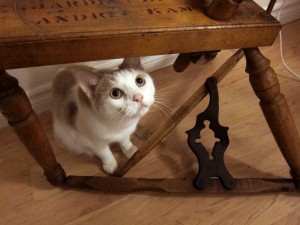
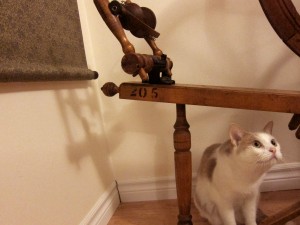
Another sign of a CPW is a maker’s mark. This can be easy or hard to locate, depending on if the wheel has been refinished, or if the maker was subtle about where they left their mark in the first place. This wheel happens to be a Desjardins, with an unmistakable mark sloppily stencilled in red paint across the table, letting you know in no uncertain terms who made it and that it came from Saint-Andre de Kamouraska. The Desjardins also numbered their wheels. Mine’s 205:
Some CPWs can be quite ornate, with flutes and beads and scallops and all kind of other fancy woordwork. Desjardins wheels… don’t really fall into that category. Don’t get me wrong, this is an engineering thing of beauty, and I think it’s certainly pretty on the aesthetic side too, but here’s a typical Desjardins decoration:

Yes, that’s red paint dabbed on the spokes. At first I thought it was the work of whoever bought the wheel way back when, but the Ravelry group informed me it’s original. Something to replace the turnings that would be seen on the spokes of wheels by other makers. I actually kind of like it.
So, how does it spin? I made a drive band from a length of cotton string and let me tell you, this is not a wheel for a beginner. There is a very narrow range when it comes to tensioning, between “too loose and the drive band flies off” and “too tight and the barely spun wool is ripped out of one’s hands.” If you’re in the right place, though, it spins beautifully. It’s smooth, efficient, and powerful. And clearly made for spinning large amounts of fine yarn, probably as supplementary income when the textiles industry was booming in Quebec. I like the fact that it’s clearly been used for its original purpose–there’s even something scrawled in cursive French on the side of the drive wheel that I can’t quite make out. I’m going to look a little more closely to see if I can read what it says.