More Montreal

It’s late (well, Toronto late) and I’m done work for the night. I’m thinking about my next trip to Montreal, which is coming right up, and about the last one, whose memories still flood my daydreams regularly. In lieu of a longer post, more from that trip:


Plateau (somewhere).


Breakfast in Mile End (bonus point if you can recognize the location from this shot).


Put a bird on it (St. Joseph’s Oratory).


Parc St-Viateur, and friends.


Le A Bar.

A few years ago, one of my best friends and I watched the Tour la Nuit from the terrasse of La Petite Idee Fixe on Parc. Great night.


Mont Royal.

Posted in travel, Uncategorized | Leave a comment

“Korean Hands for Cashmere”

About a month ago, I received a gift of about a kilo of yarn from Shanghai. It’s quite soft Merino wool, with an unusual halo of yellow synthetic fibres–I don’t usually wear yellow, but I found some matching buttons to make Kate Davis’ Owls sweater. I’ll probably start it on my upcoming trip to Montreal, which will involve at least 11 hours of sitting on a train.

The label is an odd mix of Chinese, Korean, and English. My experience with yarn from China (i.e., yarn sold in China, rather than intended for export) is limited, but elaborate English names seem to be a common convention. I’ve previously seen Love Is a Responsibility, Like is a Feeling, and now we have Korean Hands for Cashmere (which contains no cashmere at all):


In fact, it’s not even Korean. My initial assumption was that it was a Korean brand being marketed in China, but it turns out the name and the smattering of hangul on the label are just a marketing ploy. The helpful people over in the China Knitters group on Ravelry informed me that other languages carry the cachet of being foreign, and therefore superior, to domestic brands. The Ravelry group also helped me translate the yarn content, given that my Chinese is limited to a small amount of spoken Mandarin (mostly food-related) and a handful of characters:


It’s 90% Australian wool (with the ever important character for “imported” at the beginning) and 10% Japanese toray, which is some kind of acrylic or nylon. Fortunately the care instructions are listed in English… kind of:


I’m guessing the last line is “dry flat.”

Posted in Knitting | Leave a comment

Ontario Handspinning Seminar 2013

I’ve been in Ontario for five years. And for four of those years, I knew about the Ontario Handspinning Seminar (OHS), an annual conference of handspinning enthusiasts, but I was never able to go. Either I was working and couldn’t take the time off, or I was in school (and definitely couldn’t take the time off), or couldn’t afford the travel costs.

This year, finally–finally!–the OHS was in my neck of the woods. The GTA. And I have plenty of free time right now. And transportation. And with grad school and everything else going on, I completely forgot about the seminar until about two weeks after the deadline for registration.

One beseeching email later and I was sending in my registration fee along with a sign-up for a workshop on hemp spinning. I’ve never spun hemp or any other bast fibres before, and the opportunity to take class on it was something I couldn’t pass up. Before I actually showed up on Friday evening, the workshop was my primary reason for attending OHS, but I got so much more out of this conference than I could have imagined.

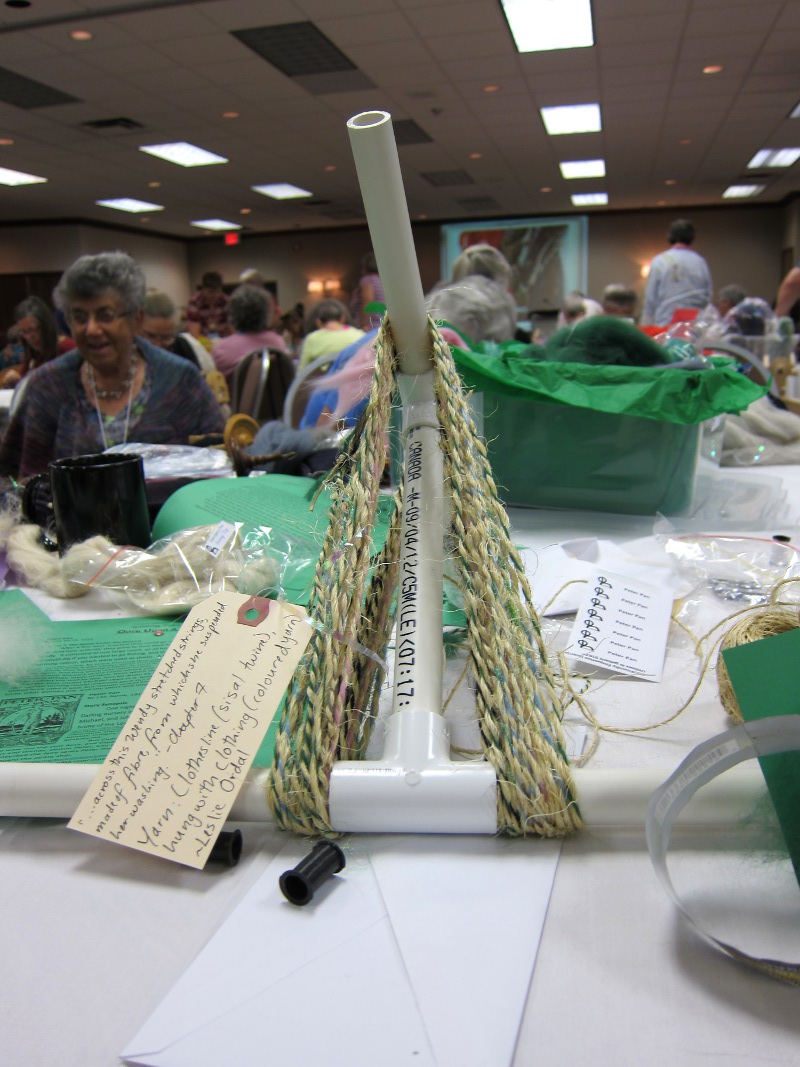
Saturday morning began with a nice, get-to-know-you activity where we were divided into groups assigned different classic books, in accordance with this year’s theme of “Spinning Tales.” Our goal was to create yarn inspired by that book in an hour. Fibre, embellishments like binding thread and sequins, and descriptive passages from the books were all prepared for us ahead of time. I ended up in the Peter Pan group, and was inspired by a few lines about (poor) Wendy, having been relegated to laundry duty in Neverland: “There was an enormous fireplace which was in almost any part of the room where you cared to light it, and across this Wendy stretched strings, made of fibre, from which she suspended her washing.” I spun several different colours of wool to represent items of clothing, each separated by a length of sewing thread, then plied it all with sisal twine:


It is, perhaps, the ugliest yarn I’ve ever spun. Overtwisted and completely useless. It was a lot of fun to do something creative within a short period of time; I heard several people around me murmuring the likes of “I like when people tell me what to spin, I’m not creative” and yet they came up with some beautiful and in fact very creative pieces.

We then split up for the workshop sessions. Mine was taught by Diny Warren, a long-time fibre artist who has spent considerable time researching hemp and other bast fibres (for you science-y types, bast fibres = phloem).


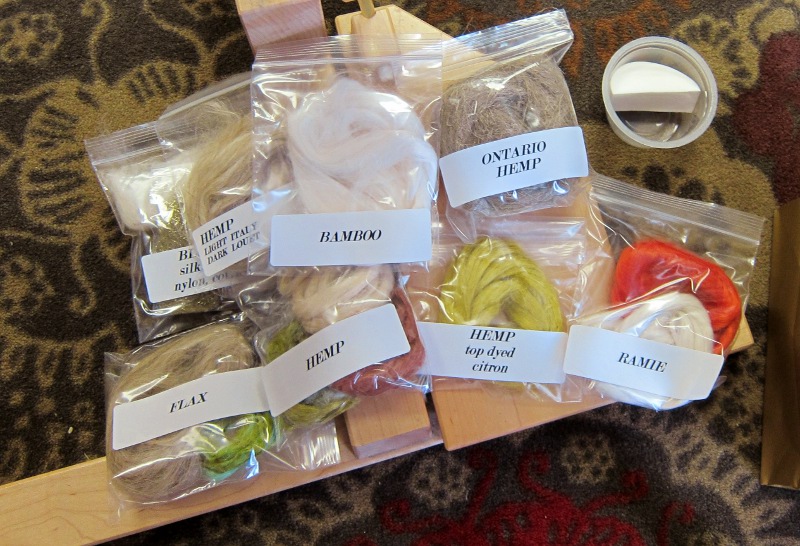
She’d been involved in a pilot project to assess the feasibility of growing hemp in Ontario, and brought us samples of everything from coarse Ontario-grown hemp (limited edition stuff; the project team concluded that obstacles regarding environmental concerns in processing were too great) to fine Italian-processed hemp to ramie to flax. She even brought us a bit of bast, as opposed to rayonized, bamboo.


She quickly dismissed a few of my previously held notions about hemp and other bast fibres, such as: 1) they are hard to spin (actually, no), and 2) they are wonderfully eco-friendly (yes in the growing phase, but the processing can be very toxic). I was really surprised at how easy and enjoyable they were to spin. Unlike wool, bast fibres have no scales and no crimp and therefore no elasticity, but I had no problem spinning a strong yarn as long as I had enough twist. It was helpful to have Diny there to give feedback (Leslie, add more twist) and encouragement. Trying a new fibre can be surprisingly intimidating, perhaps because spinners tend to be stingy types who are afraid of “wasting” anything. It helps to have someone put the fibre in your hands and say, “Here, spin this.”

So I successfully got my feet wet in the world of bast fibres. Diny also read us Rumpelstiltskin and brought hemp brownies (seriously). I also was very impressed when I had a last-minute wheel malfunction (OF COURSE) and no fewer than three conference organizers came to my rescue.

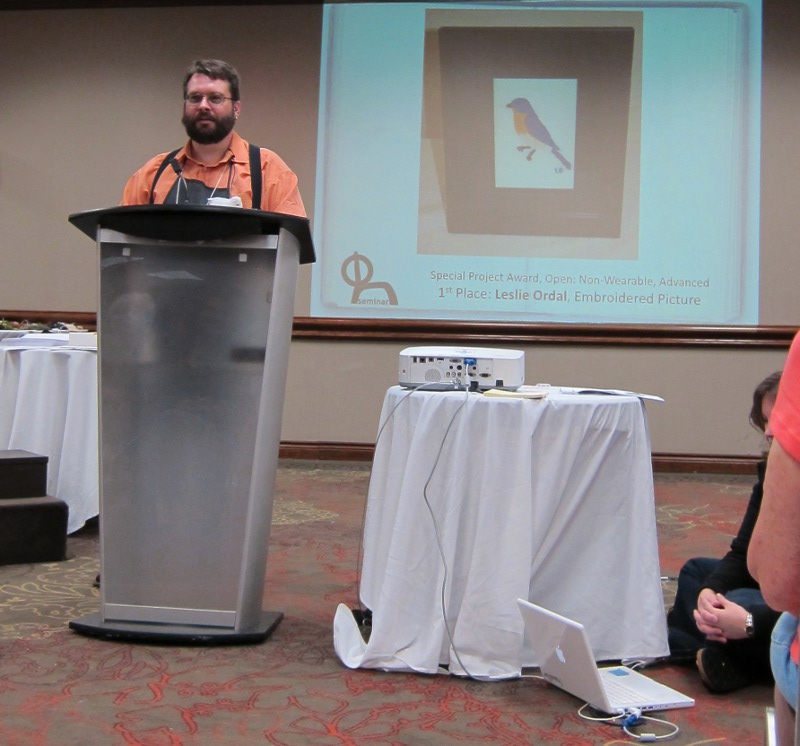
I had originally planned to just attend the Saturday workshop, but I came back on Sunday because I had a few items entered into the competition. The feedback and comments on my entries were in line with what I was expecting, and very constructive. I had decided to push myself, technique-wise, and all my yarns represented new skills, such as supported spinning, wider-diameter yarns, and embroidery. My embroidered piece (inspired by Charles Bukowski’s poem “Bluebird”) also won the Advanced Non-Wearables category, so I was pretty pleased about that:


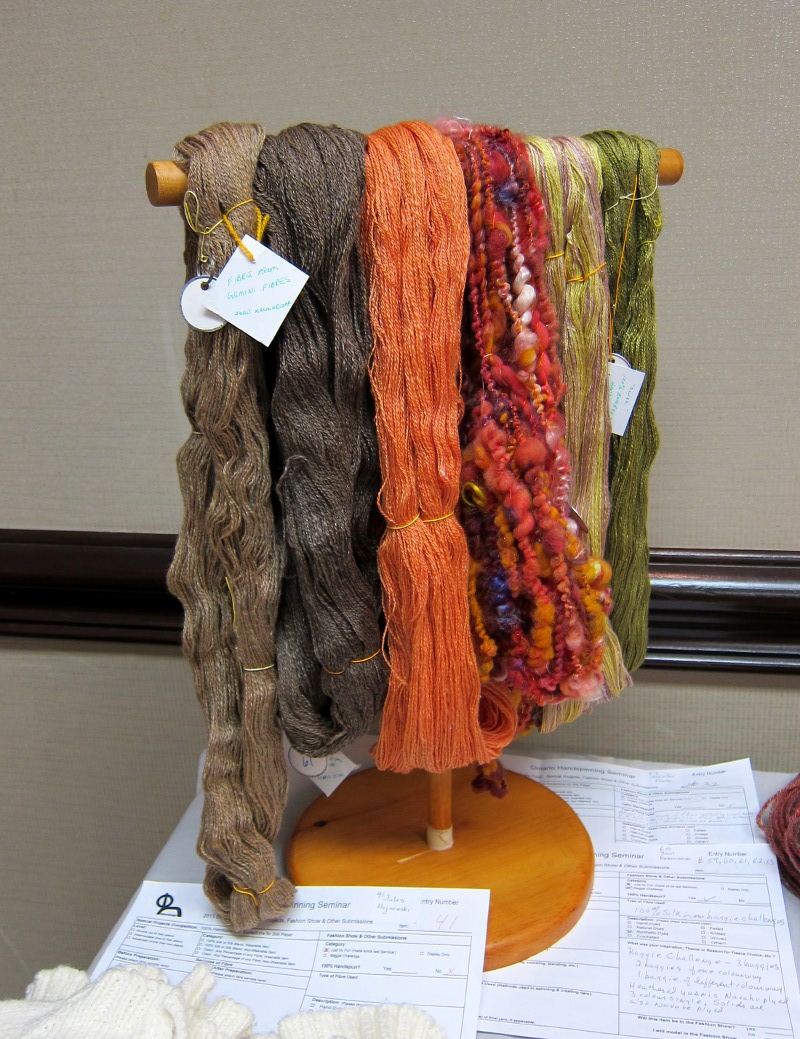
The skill and artistry in the display and competition items were stunning. I was surprised at how many pieces were entered in the “Just for Fun” category rather than being up for judging. They would have soundly, and deservedly, kicked my ass:


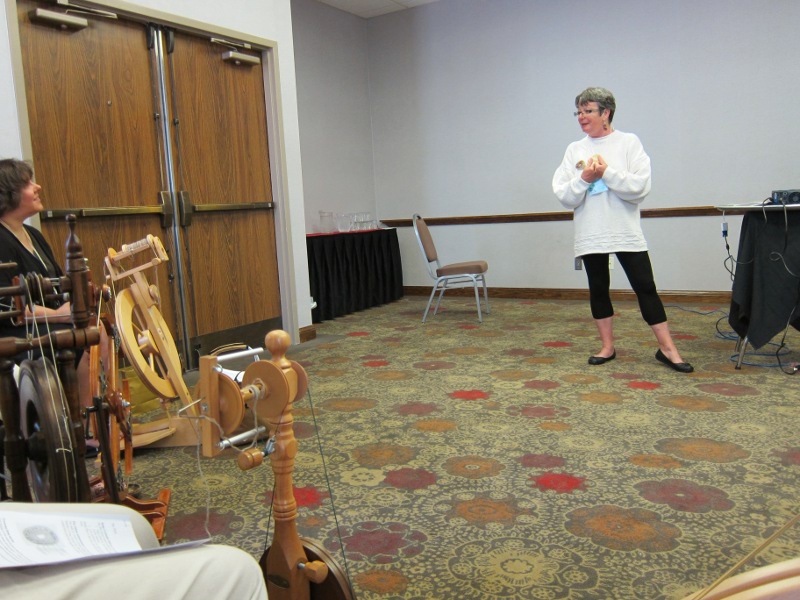
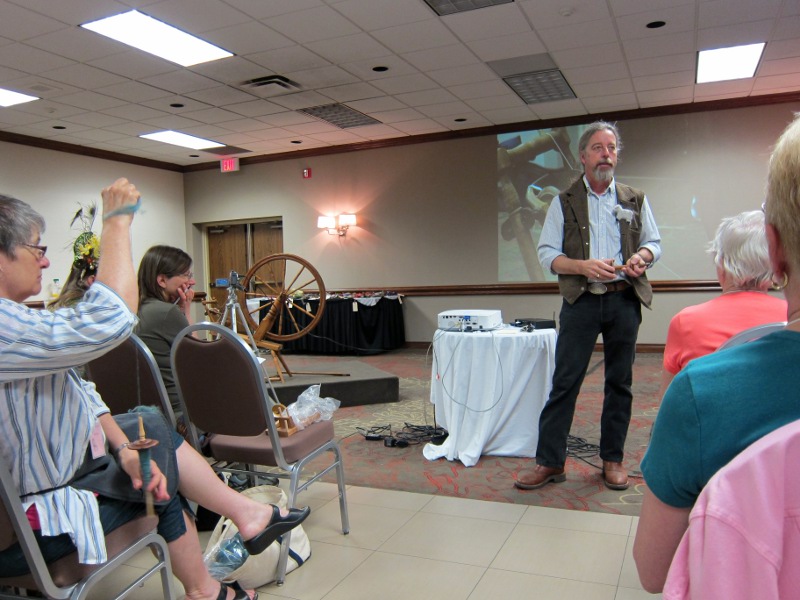
Also on Sunday was a lecture by Reed Needles, a wheelwright/watchmaker/harness-maker/many-other-things who talked about antique wheels. He had a great sense of humour and shared several enlightening facts, especially about Canadian Production Wheels (which he called the John Deere balers of spinning, given their rather utilitarian design and purpose). He demoed a lathe, which immediately made me want one–because sawdust would look great strewn around my apartment in downtown Toronto, and brought us all handmade orifice hooks. Reed, you sure do know how to please a crowd full of people with a weird hobby.

In the photo above, you can see why raising your hand at a spinning conference doesn’t necessarily mean you have a question (drafting joke).

Overall, I can’t say enough good things about the OHS. Everyone was friendly, enthusiastic, and helpful to a first-time attendee like me. I learned a lot and was inspired to check out the spinning and weaving guild in Toronto. Unfortunately next year’s seminar is the same weekend as my Wellesley reunion, but there’s always 2015…

Posted in Spinning, Uncategorized | 7 Comments

Montreal

Nothing much to do with fibre arts in this post, other than to say that I did progress quite a bit on my Hey Hey, My My project in the car on the way to and from Montreal (11 hours round trip = lots of knitting time).

It was, essentially, a perfect vacation. The only thing I would have changed is to have gone for longer than a weekend. I’m back in Toronto now but my mind still wanders quite readily to these beautiful places:


St. Joseph’s Oratory


Church on Mont-Royal


Parc St-Viateur


Yum.


Laika, mid-rainstorm.


Parc Lafontaine, sometime after midnight.


Relaxing at the top of the mountain.

Posted in travel | Leave a comment

Aurora Yarn

At last, I finished spinning the aurora batt. This project came about through a series of events that involve hand-thrown pottery, the northern lights as seen from Ontario, a Boston convent, and one of my spinning classes in Toronto. It reminds me that just about any experience is reliant on dozens or hundreds of interconnected happenings before it.


It was a delight to spin. Primarily wool, it was peppered by bits of more lustrous fibres, such as silk noil, mohair, and firestar. These shinier elements stand out in the final yarn, even through the chain-ply, and bring to my mind stars and meteorites.


The project went essentially as planned, with a couple of minor issues with a few meters that ended up being all mohair and prone to drifting apart. What I’ve learned for next time is to great increase the twist in those sections of slippery fibre, then drop it back down again for the wool.


The twist in the ply is greater than the twist in the singles, so it appears a little bit curly when freshly off the bobbin. The unbalanced twist energy will easily block out in the final knitted scarf. Unlike a number of spinning experts out there, I don’t think a yarn should always be perfectly balanced (although if I’m spinning for competition, I’ll take the “smooth and balanced” requirement quite seriously). There’s a lot more options in yarn design if you relax the “singles twist must be equal and opposite to ply twist” rule.


What I’m really pleased with is how the colours turned out. They’re in separate sections, for sure, but there’s a nice gradation between colours as well. I think they mimic the original image very well.


The next step in this multi-part endeavour is knitting the yarn into a scarf/wall-hanging. My part is done but I can’t wait to see the finished the product.

Posted in finished object, Spinning, spinning wheel | 4 Comments

Progress on Hey Hey, My My

The first item that showed me the magic of blocking was a lace baby blanket I made back in 2007. Blocking, for those of you unfamiliar with the term, is washing a hand-knitted (or, I suppose, crocheted) item so as to affect its final shape. It often involves stretching the item as it dries to help smooth out uneven stitches and get cleaner, neater lines. It seems to have the greatest impact when used with lace, which opens up dramatically when blocked, as it did with the baby blanket. It should be noted that blocking only works with natural fibres–synthetic fibres like acrylic cannot be persuaded to change their shape in the way that protein and cellulose can.

I’m really, really hoping blocking will do something magical for my current project. Maybe it’s due to the cotton yarn (which I rarely knit with), but its current resemblance to a mashed Yoda mask is not encouraging. Hard to see in this photo–but I promise are there–are a lot of uneven stockinette stitches. Can’t even blame it on drunken knitting, but there you go.

I’m sure blocking will help open up the blackberry stitch yoke, too. Now that I’m done with that part it’s actually coming along rather quickly–I might need to have another project ready for my trip to Montreal. Which will be something much less tedious and requiring very little attention to detail (see the aforementioned drunken knitting).

So, for those of you who work with cotton more than I do: can I expect blocking to even out my stitches in this cotton yarn?

Posted in blocking, cotton, Knitting | 1 Comment

Back seat knitting

With a 5-6 hour car ride to Montreal coming up, being faced with dozens of rounds of repetitive stockinette in the Hey Hey, My My pattern by Reiko Kuwamura suddenly doesn’t seem like such a bad thing. I’m past the tricky blackberry stitch yoke, and now only have to pay attention every 15 rounds or so for decreases and increases. No pics just yet, but I did try on what I’ve knit so far and it fits really well in the shoulders, which is unusual (normally everything is a little bit wide).

The cotton yarn I’m using is from Elann, made by an Italian mill. I usually try to use local or handspun yarn as much as possible, but the reality is that cotton just doesn’t grow this far north. One fibre that does grow well up here is hemp, which I’ve never spun but will be the subject of a class I’m taking next month. Cellulose fibres have never been my favourite spinning material but I’d like to expand my skill set a bit. And who knows, maybe I’ll be as excited about bast fibres as I originally was about, say, alpaca…

Posted in cotton, Knitting | Leave a comment