Spinning for embroidery

Shortly I’ll post about my a trip I took to the Laurentians back in August, which included a stop at Laurentian Alpacas, the source of the fibre for the project in this post. For now, though, a bit about my ambition to spin embroidery thread from local materials…

For the past several months I’ve been mulling over ideas for using fibre as a medium for art, rather than its more craft-designated use as a base material for garments (the distinction between art and craft is something I’ve been mulling over too, but that’s something for another post altogether). Many fibre artists use felt and create beautiful work, but my limited forays into needle-felting haven’t been too inspiring for me. Scrumble crochet leads to some amazing pieces, but I haven’t found that to be for me either. Rather coincidentally, I started thinking about getting into embroidery right about the same time I discovered a brand new website devoted to the topic. I was excited to learn and use the techniques on the site to create my own pieces but, as with most of my other textile activities, I thought why not spin my own yarn for it? I went a step further and decided to use fibre only from local, small-scale farms (and am kicking myself for not bringing home some wool from my visit to Pine Hill!).

The yarn for crewel work, a type of embroidery done using wool, is a worsted 2-ply from long-stapled fibres such as Border Leicester. I had some fairly long-stapled alpaca combed top–Laurentian Alpacas had one fleece milled into top this year, and I bought a significant chunk of it–and gave it a go. Using the fast flyer on my Lendrum, I spun a fine worsted yarn that I then plied:

It was tricky getting the right balance between enough twist to hold the single together, but not so much that it felt wiry and inflexible. Fairly typical of spinning alpaca worsted, I think. At any rate, I’m pretty happy with the results but the true test will be when I try it out in its intended purpose. I’ve got some mohair locks to try out next, and next time I’m in Montreal I’ll probably pick up some of the Border Leicester at Ariadne…

Posted in embroidery, Spinning, sustainability | Leave a comment

A trip to Pine Hill Farm

A couple of weeks ago I made a visit to Pine Hill Farm in Hemmingford, Quebec, about one hour south of Montreal and close to the New York border. As part of an article I’m writing for Spin-Off, I decided to feature Pine Hill as a source of fleece and other spinning fibre in the Montreal region. I’d already seen their product for sale at Ariadne Knits (including yarn made from a sheep whose fleece is inexplicably uniformly canary yellow) and their small Border Leicester flock in scenic Hemmingford seemed like an excellent choice for the article.

When I made contact with the owner, Anna-Maria, she asked if I’d be open to teaching a spinning workshop for her and a couple of friends on the day of my visit. So, with spinning wheel, camera, and a lot of coffee in tow, I made the three-hour drive into southwestern Quebec. The area alternates between apple orchards and stands of sugar maples, and as such receives a healthy bit of tourist traffic in early fall and early spring.

Pine Hill itself sprawls across acres of rolling, rocky land and is home to a few dozen Border Leicesters and crosses, seen here walking back to the barn:

Anna-Maria could name every sheep as it walked by and tell me about the characteristics of each one’s fleece. Most were wary of us but a few bottle-fed lambs walked right up for a pat:

Speaking of the fleece, it was beautiful–Border Leicesters have a medium wool with a high lustre that grows in tight ringlets. I learned that the Border Leicester was the favoured breed in this part of Quebec, brought there by Scottish immigrants and popular because of their strong fleece and hardy constitution. Border Leicester ewes are good mothers and the breed does well in harsher climates. Fleece, on the sheep:

Teaching the workshop was a bit of challenge due to the wheels involved–two participants had antique Quebec production wheels, originally made for spinning great quantities of very fine yarn as fast as possible, and tricky even when in pristine condition. Most of the antique Quebec wheels out there are in need of repair or at least adjustment, and the ones in the workshop certainly fell into this category. I was impressed at the tenacity of their owners, though, who kept spinning despite the wheels’ tendency to suddenly stop working. Everyone spun a bit on my Lendrum and was amazed that spinning could be so easy and trouble-free! I’d love to get my hands on a restored Quebec wheel, actually–emphasis on restored. ;)

Anna-Maria and I also took a trip down to the road to Sue Heller’s farm, home of the annual Roxham Wool Gathering which draws participants from Montreal and beyond (including my friends at Ariadne). Sue’s got a small flock guarded by a geriatric and very well-bred Thoroughbred mare named Maggie. Maggie was initially unsure of these strange woolly creatures but now guards them as well as any dog:

It was great to meet Sue, who has been spinning for years and years. She was surprised to learn of the popularity of spinning in my former home of Colorado, as it really hasn’t experienced the same kind of renewed interest in Quebec that it has elsewhere. I speculated that up until fairly recently, spinning in Quebec was far from a leisure activity–it was work, and there was lots of it to be done to bring in even a small income. Sue told me that on the old Quebec farms, older unmarried female family members (“spinsters,” if you will) were allowed to spin by the fire as cold temperatures caused the wool to break. (Something Sue found out for herself at an outdoor demo in early spring one year.)

Sue dyes much of her yarn herself, and experimenting with a copper mordant (and no dye) she came up with the light green shown in the little rat here. I thought he was Yoda, at first (come on, don’t you see it?):

At the end of a glorious fall day I headed back through the maples and apple farms, over the St. Lawrence river (a few times), back to Ontario. Look for the photos in Spin-Off’s spring issue next year.

Posted in Spinning, sustainability, teaching, travel, yarn stores | 3 Comments

Win at Lambtown

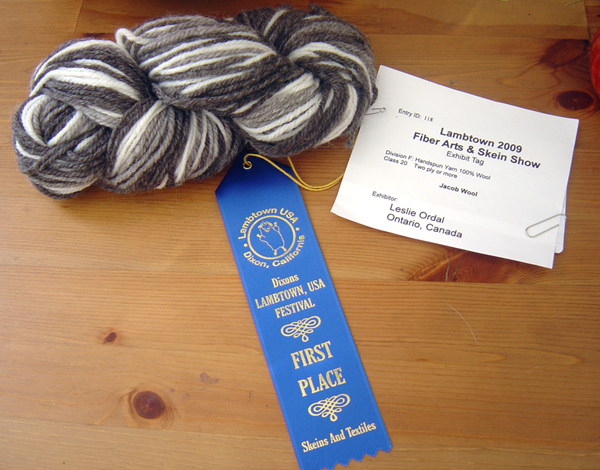
This month, I mailed off my Jacob wool skein to the Lambtown fiber festival in Dixon, CA. I entered it in the plied wool skeins class, and it came home with this:

The competition organizer told me it was in a large class, and also won a special award from Meridian Jacobs for best Jacob wool item. This was my first time entering a skein competition, and I couldn’t be happier!

Posted in jacob, Spinning | 2 Comments

Blog Action Day — Climate Change and Cashmere

I’ve written before on the negative environmental effects of the cashmere industry, but for this year’s climate-change-themed Blog Action Day I’d like to write on the subject in greater detail, and how knitters and other fibre artists can avoid contributing to the problem while not giving up the chance to work with luxury fibres. My sources are listed at the end of this blog, should you want to read more.

Up until very recently, cashmere truly was a luxury item: produced in small quantities of a high quality and commanding high prices in a select market. Grown predominantly in central Asia, most cashmere was milled in Scotland and Italy with the finished garments known for their softness and long life. The explosion of Chinese textile mills in the 1980s began to alter how cashmere is produced and sold, with the changes accelerated by relaxing of EU tariffs in 2005 that allowed cheap cashmere to flood the market. These garments were by and large lower quality than their Scottish-milled counterparts, but their low prices (and the cachet of the word ‘cashmere’, no doubt) resulted in a very high demand.

In response, cashmere growers increased the size of their flocks, and many people who had never raised goats purchased their own herds to take advantage of the demand. Goats, whose sharp hooves tear up the soil and have foraging habits that strip the land of all vegetation, replaced lighter-grazing sheep as the predominant livestock animal in the steppes of Mongolia and China. The end result has been a worsening of the desertification occurring in the region–between 1994 and 1999, the Gobi desert grew by an area the size of the Netherlands, and the incidence and severity of duststorms has risen dramatically. These duststorms even affect air quality in North America, with Asian-originating dust accounting for as much as 40 percent of the worst dust days in the western US. The goats themselves suffer as their grazing areas become desert, and it is not uncommon for them to starve. The situation has not worked out well for the herders, either, as they lose their livestock either to starvation, or government-mandated culls designed to combat desertification. Many nomads living in Inner Mongolia have had to give up their livelihood altogether, unwillingly relocated to cities after generations of herding goats on the steppes.

As I mentioned above, many of the cashmere garments exported from China are of a lower quality and wear poorly. A few years ago I had the opportunity to speak with Angus McColl, of Yocom-McColl Wool Testing Labs in Denver, about cashmere production. He said that most of the Asian “100% cashmere” samples he tested contained wool or other fibres. The cashmere fibres themselves in Chinese-produced garments are often coarser and shorter, and therefore less soft and more prone to pilling, but with an attractive low price.

Some companies only buy cashmere produced sustainably, i.e., from goats kept in pens rather than allowed to openly graze the steppes, with the herders paid fairly for their clip. Linda Cortright, of Wild Fibers magazine, has spearheaded an effort to educate nomadic Asian cashmere producers on how to best sort their fibre in order to ask for better prices. In addition, some cashmere is produced sustainably in North American, though not nearly as much as in Asia.

So what does this mean for the knitter/fibre artist who wants to work with a luxury fibre like cashmere, but doesn’t want to contribute to the environmental disaster of desertification? Unfortunately, it’s not always possible to know if a cashmere yarn or other item was produced sustainably. Even high-quality cashmere may come from a non-sustainable herd. Until sustainable cashmere growing practices become widespread in Asia, the best thing a concerned knitter can do may be to buy only North American cashmere products, or substitute another luxury fibre such as alpaca, and certainly avoid any cashmere that seems to be priced much lower than it should be. I would encourage anyone buying cashmere, as with anything else, to fully investigate claims of sustainability made by a manufacturer. Ultimately, for the sake of the environment, the nomadic cashmere growers, and their goats, the ideal solution is to reduce demand. Cashmere is an example of the negative environmental and human impacts that can occur when a luxury good becomes commonplace, and should serve as a reminder to us to reduce consumption wherever we can.

Sources:

Mongolian Herdsmen No Longer Free to Roam
Green grass of steppes falls victim to West’s stampede for cashmere
A gripping yarn
That low-priced cashmere sweater has a hidden cost
Woolly thinking
Fibre people — Linda Cortright

Posted in Uncategorized | 2 Comments

Blog Action Day… tomorrow

I hate to do this, but my Blog Action Day post will have to go up tomorrow. Note to self: write stuff in Google docs, not in Word, just in case your computer crashes and can’t be recovered for 24 hours.

Cashmere production tomorrow!

Posted in Uncategorized | Leave a comment

Jacob wool, and being consistent

Way back when, I bought a part-fleece from a Jacob sheep at the Rocky Mountain Natural Colored Sheep Breeders’ Association (what a mouthful, just imagine what it’s like writing even the acronym on a check), one of my favourite vendors at the Estes Park Wool Market in Colorado. Here’s the fleece posing artistically with my cotton cards for a promo photo for one of my classes:

Last summer I partitioned the spotted fleece into three sections: white, black, and border areas with a bit of each mixed in. With my then-new wool combs, I made these bird’s-nests of top:

Before I could spin it, life got crazy with a couple of international moves, career changes, etc. Well, I finally got around to spinning it over the past couple of weeks, creating a self-striping yarn (oh, chain ply, how I love your ability to preserve colours) that I tried to make as light and lofty as possible. I made two skeins’ worth, and even though I concentrated on spinning them the same way, the second bobbin of singles was slightly denser and thinner than the first. I now understand why some skein competitions include a “handspinner’s basket” category, where larger amounts (8 oz. of yarn, versus the typical 1 or 2 oz.) must be submitted: it’s difficult to be consistent in your spinning! I should’ve used a control sample, which is a short length of yarn pulled off your bobbin to keep nearby as a visual reminder of what you’re aiming for. I always encourage my students to do this, but hey, do as I say, not as I do, right?

Regardless of the inconsistency, I’m still very happy with the results:

Super lofty and soft, just what I wanted. I’m so pleased with it I’ll be entering it into a skein competition, along with a few other nice skeins I’ve been saving up for that purpose.

Posted in jacob, Uncategorized | 3 Comments

Waffles for Brunch for Botswana

I still haven’t made my first “grownup” sweater–I have all the yarn for Ardent but the daunting task of the knitting math needed to alter the sizing means that for now, I’m sticking to my old habit of easy, instant-gratification (well, relatively instant) kids’ sweaters.

Such as Waffles for Brunch, made for The Botswana Project and their recent drive for sweaters:

It was a very satisfying knit–fast, simple, and yielding an extremely warm and useful garment. I really like the pattern as a charity project, because it takes so little skill and really does make for a warm sweater. I used some recycled Jaeger Shetland (85% wool, 15% alpaca) I had kicking around the stash for the last five years, and four skeins produced a sweater that would fit a small-ish child. The only thing I wasn’t quite happy with was the presence of a few holes after picking up stitches for the sleeves, but I filled them in with some extra yarn at the end.

Sometime I will sit down and work out the math for Ardent. I liked math in school, all the way through calculus, so why is figuring out how quickly and where to make my decreases such a pain in the ass? This is obviously why I’m not a designer.

Posted in charity, finished object, Knitting | Leave a comment