
Maisonneuve invited me to blog about yarn bombing (knit and crochet graffiti), specifically a new book on the topic by Leanne Prain and Mandy Moore. You can read my guest post here.

Maisonneuve invited me to blog about yarn bombing (knit and crochet graffiti), specifically a new book on the topic by Leanne Prain and Mandy Moore. You can read my guest post here.
I’d said for a long time that I wasn’t going to take up weaving, at least not in the near future. Although it’s a logical next step in textiles after knitting and spinning, the costs involved (full-size looms run several thousand dollars) kept me from even considering it until a few months ago. That’s when I started to listen to people who said, “You can get a rigid heddle loom for a couple hundred bucks” and “weaving is a great way to use up all that yarn you spin and don’t know what to do with.” I was therefore in the right state of mind when I saw a rigid heddle loom for an extremely low price on Kijiji.
After exchanging cash with a guy in a Tim Horton’s parking lot in rural Ontario, I became the owner of a 24″ Leclerc Bergere loom manufactured sometime in the 1970s:

One of the great things about Leclerc is that they’ve been around forever and support all of their looms, no matter when they were made. This loom is still manufactured, although I’m told some of the wood has been replaced by plastic. Thanks to a lesson from Elizabeth, I was able to get it set up without having to rely on the somewhat arcane documentation that accompanied the unassembled loom in the box. Here it is as I thread the warp ends through the heddle:

One thing I learned about this loom is that it mimics the design and set up of a floor loom as closely as possibly, so it’s a good model to learn on if you’re going to eventually move up to something bigger. It’s meant to be used on a tabletop but I found that put it at an awkward height, and had better luck on the floor or holding it on my lap. It would benefit a lot from having its own stand (unfortunately, Leclerc doesn’t make one for it). It is very easy to weave on, though, and it goes satisfyingly quickly once it’s warped. Here’s a regretably blurry shot of the first inch or so of a scarf:

The yarn is Briggs and Little, hand-dyed by Elizabeth. She also dyed the yarn for Heidi‘s scarf, shown here on a Schacht Cricket loom:

I really like how portable the Cricket is, and how it fits comfortably in your lap, and has notches in the back if you want to lean it against the edge of a table. I could see myself getting one of these at some point, but I’m getting way ahead of myself here… Anyway, here is what the scarf looks like after I finished weaving, washed it, and trimmed the fringe:

I’m amazed at how quickly it went (much faster than knitting), how much yarn it used (so much for relying on weaving to use up all those partial skeins I have sitting around), and how addictive it was. I don’t have any other projects planned but I’ll dig through my handspun yarn soon and see if I’ve got enough for another scarf.
Last time I combed mohair locks (again, for embroidery thread) I was frustrated with the how static made the slick fibres fly all over the place. It was a little difficult to control, both in the combing and spinning, so for the next batch I decided to use combing oil.
There’s no one type of ‘combing oil,’ in fact I could find very little in the way of recipes or even descriptions of what it might be. With the help of Ravelry, however, I came up with a spray bottle filled with a cup or two of water, a few tablespoons of olive oil, and a few drops of lavender oil. Shake well, spray, comb. This does add an extra step–washing the finished yarn–to the process, because the remaining oil on the fibres will eventually go rancid. Mineral oil doesn’t go rancid and I believe some people use that, but I’d rather not use a petroleum product if I don’t have to. Also, some spinners wash all their yarns anyway, so it may not even be more labor-intensive than usual. I took some photos of the process, starting with the raw locks loaded on the comb:

After a good spray with the combing oil and the first pass on the combs, the locks look pretty fluffy:

I sprayed them down quite a bit more before the next pass, which yielded much tamer fibres. The oil helped a lot with keeping them under control:

Yet another spray down before pulling the finished top through the diz (in this case, a button):

And finally, a nice tidy bird’s nest of 100% mohair top:

There was a lot of waste afterwards, probably around 50% of the total fibre. I’ll use this for carding, probably blended in batts, or it would likely do fine spun on its own from a cloud:

For comparison, here’s a pile of top from my earlier, no-oil combing session next to the batch combed with oil. There is slightly more of the magenta stuff there, but even so you can see the difference the oil made:

Overall, I’m really happy with the results and will use the combing oil again, perhaps even for less slippery fibres. It’s now spun up and washed, and ready to be used for its intended purpose. That’ll be another post!
In my post about Pine Hill Farm, I neglected to mention that the owner, Anna-Maria, is an accomplished hand-dyer. She works mostly with a merino-tencel blend that she uses for felting scarves and other objects. Before I visited her farm in October, I saw this example of her work for sale at Ariadne:

I loved the colour combination, especially the little spots of green among the blue and the orange. I wanted to preserve the colours as much as possible in the finished yarn, something I usually do by chain-plying, but I also wanted to make a laceweight yarn. One of the drawbacks to chain-plying is the little bump you get at the start of each chained section, something that usually gets hidden in a thicker yarn but stands out quite a bit once the WPIs go up. So, I decided to split the roving lengthwise and spin it in two parts, and hope that the colours matched up. Each half of the roving I split again three times and spun them in the same succession, and the resulting yarn matched up… pretty close. In some places the colours match, but there is a little bit of barber-poling in other sections, and the colours faded immensely once they were thinned out to laceweight width. Well, good enough. You can see where the orange mixes with the blue in this picture:

With only two ounces I was limited in what I could make with the yarn. I thought perhaps I could get a shawl out of it, and worked a simple trianglular leaf lace pattern, starting from the apex and working up:

Pretty, I think, despite the uneven stripes. However, halfway through the ball it’s clear I don’t have nearly enough for a shawl, and unless I start over it will be destined to be purely decorative. As much as it hurts to rip back all that work, I’m going to start again and make a narrow rectangular stole out of it (although keep a leafy pattern).
I frequently buy dyed mohair locks from a local angora goat farm, Wellington Fibres, for my intermediate spinning class. As part of my recent fascination with embroidery, I tried out the mohair as a potential material for thread, with fairly good results. The next batch I’ll get some photos up of the whole process, from locks to combed top to spun thread, but for now here’s the finished product:
The first bit I spun about as fine as the alpaca top in my last post:

Mohair, in case you’re wondering, is a trickier fibre than wool to spin. It’s a very smooth fibre with a wave to it rather than crimp, and though it takes dye like nothing else, it’s really got to be convinced to hold itself together in yarn form. After my singles drifted apart a couple of times I realized I needed more twist than I was used to. For the second attempt, I decided to go finer, and therefore put in a LOT more twist. Even on the smallest whorl on the fast flyer I still had to be conscious of adding more twist. I do like the finished result, though:

That’s close to the finest I’ve ever spun, I think. And how does it work in its intended purpose? I practiced a few stitches on an old dark blue quilt block and they came out pretty nicely, but unfortunately getting good photos of the result eluded me. I’m going to try again on plain, natural twill and with any luck the stitches will show up better. Either that, or get a new camera already.
For all of the courses I teach, I send like to send participants home with class notes that they can reference later. I cover a lot of material and it’s easy to miss a detail or two, and it frees up students from having to write anything down. In the past I’ve had booklets printed up and handed them out at the start of class, which has worked fine, but I usually end up with a few too many. Given that I’m always updating the notes, I’ve ended up with a stack of older booklets that I don’t have much use for, which is both a waste of money and an unnecessary negative environmental impact.
When I taught at Ariadne a couple of weeks ago, however, I decided to offer my students a choice: I could either email them a pdf of the notes after class or mail them a hard copy. Everyone enthusiastically chose the pdf, saying they’d prefer to save paper and were more likely to lose a printed booklet, anyway. So, from now on I’ll offer all of my students the same choice. I usually have one or two people who don’t have email, and I’ll be happy to mail them a hard copy, but I predict the pdf will remain the more popular version, and I’ve solved my problem of excess outdated notes.
All that being said, for my next intermediate spinning class, I will be having one sheet of cardstock printed up for each participant. I took a few classes from Kaye Collins back in Colorado and she gave us all yarn sample cards to save lengths of each type of yarn we spun, along with a few lines to note the style of preparation and spinning:

I’ve used it a few times to help myself make similar yarns to the ones I spun in her classes. I also like the tactile part of it; notes can tell you a lot but being able to see and feel the yarn is a greater inspiration to try spinning that way again:
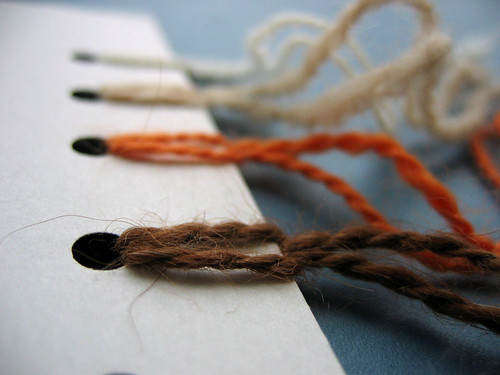
Like Kaye, I use a variety of preparations and fibres in my intermediate-level class. Although everyone goes home with a chain-plied sample skein of everything they spun, I think the addition of the sample card (as well as the usual notes) will help keep everyone confident and inspired to practice the new techniques they learned.
A few weeks back, my post on cashmere and climate change was featured on the Maisonneuve blog. Thanks to the Maisy staff!