New (old) toy

It’s been a busy few weeks. Between graduate school interviews and the accompanying travel, not to mention work and more work, I haven’t exactly had time to update the blog. I have been getting some spinning in, however, especially on my supported spindles. Yes, plural. Technically I have three now, between the Grippingyarn Russian-style, the brass takhli, and now an antique Bulgarian number I got for a pittance on eBay:
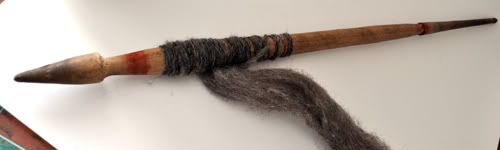
(Somewhat diminished photo capabilities at the moment. My DIY lightbox, which consists of a cardboard box, tissue paper, and a sheet of Bristol board, suffered an attack by the small carnivores I keep in my house. It’ll be rebuilt soon.)

It’s pretty big, maybe as long as my hand and forearm, but surprisingly light. No idea what kind of wood it is, but like most Bulgarian spindles it has painted green, red, and blue stripes. I’m not sure if they serve a purpose other than decoration, but it’s possible they indicate how far to build up the cop of spun yarn. Interesting too is the little knob on the end:
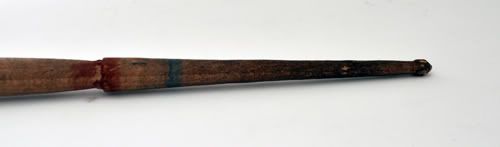
Some supported spindles have grooves cut into the knob for the yarn to sit in as one spins, but not this one. It may still be a means of keeping the yarn in place as the spindle turns. I’m really starting to get the hang of supported spindling now, whereas before I really struggled with it. The epiphany moment was realizing I shouldn’t add so much twist before I begin drafting. With a short worsted draw on a drop spindle or a wheel, I might pack in a lot of twist at first, then let it into my drafted fiber a little at a time. The one-handed drafting needed for a support spindle doesn’t allow for this, and the fiber drafts much more easily if only a little twist is going into it at a time. Now I know to twirl the spindle a bit, draft a little, twirl some more, draft a bit more, etc.

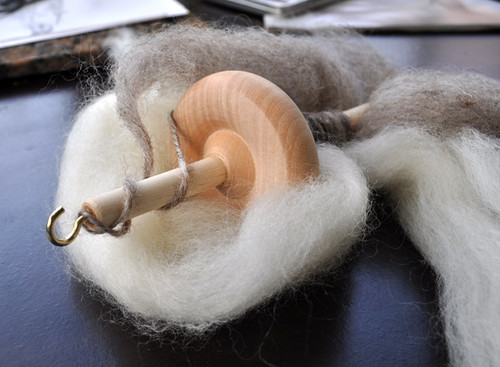
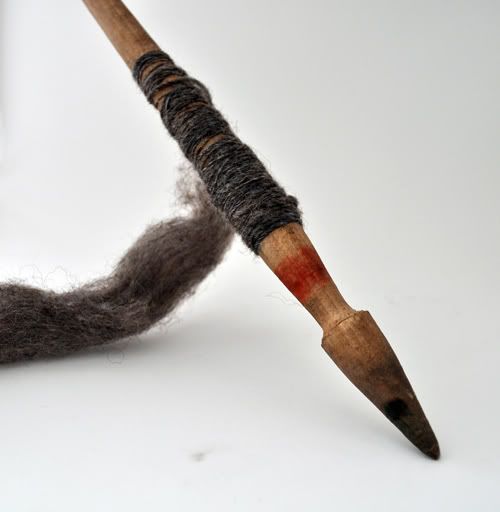
Fiber preparation also matters a lot if you want a smooth yarn. Smooth prep equals a consistent yarn, anything yields lumps and slubs and thin spots. I really prefer prepping the fiber myself, but I’ve managed with a heavily predrafted commercial Coopworth roving:
All in all, I really enjoy supported spindling. Possibly even more than drop spindling. Perhaps a little more than spinning with a wheel!
Posted in Feature, spindle, Spinning, supported spindle | 2 Comments

Sewing Techniques class

Given that I’ve had my sewing machine for just over two months, I was really looking forward to my class on basic techniques at a quilting store in Orleans. My main interest in sewing is making clothes, but most classes on making a garment fall well outside my price range. I’m at the point in sewing that I was in knitting about eleven years ago: everything is new and intimidating and seems beyond my ability. I just can’t afford to pay $300 to learn to make a skirt, though, so I figured the next best thing was to learn some common techniques and then take a stab at a simple pattern myself.

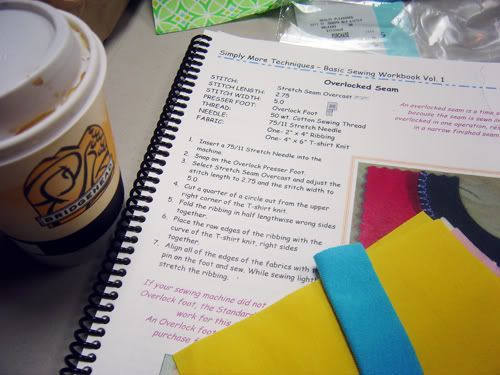
It was an all-day class on a slushy wet day, so I was grateful to pull off my boots and sit down with my coffee and get started. Although the class was based on the step-by-step exercises in a published workbook, the instructor brought so much more to the course than I could ever have gotten out of a DIY book. Carol Voyer-Terrien has over forty years of sewing experience and seemed to have a tip or shortcut for everything, whether it was buttonholes or working with stretchy fabric or certain stitches.


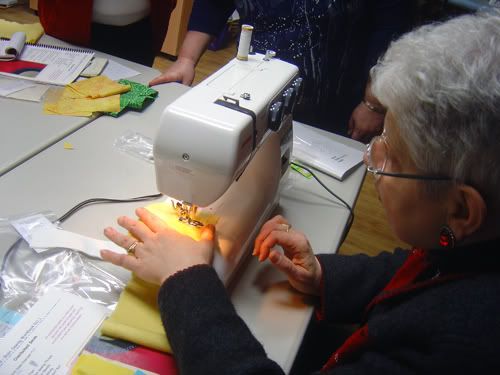
Carol demonstrating a technique on my machine

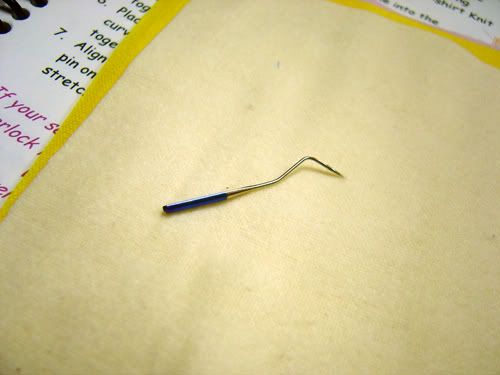
As is frequently the case in Ottawa, we had a mix of English- and French-speakers in the class. Most of the instruction was in English but I was able to learn some sewing and textile vocabulary in French by listening to Carol converse with the Francophones. I also learned that you can’t use Janome’s overlock foot with a straight stitch:

At the end of the day I’d amassed a stack of successful and sort-of successful samples. I need more work on a few things, but now I can confidently put in a zipper (my main goal), make buttonholes, create gathers, and sew ribbing to knit fabric on a curve:

I picked up some cotton on sale after the class, and an A-line skirt pattern the next day. I also encouraged Carol to consider offering classes on sewing clothing–there was definitely interest among the students, and I’d love to learn more from someone with her kind of training and experience. Once I pick up some cotton voile for the lining (possibly on a trip to NY this weekend), I’ll get started on that skirt.

Posted in sewing | 3 Comments

Your Yarns submission, accepted

So my submission to Spin Off’s Your Yarns section was accepted. While it didn’t make it into the magazine, it is in the expanded online section available here (registration required). Lesson learned from this exercise was that if I submit again, I should use a darker fibre–you can barely see my yarn against the white background!

Posted in alpaca, Spinning | 4 Comments

Buttons in Montreal

Last Thursday I made a quick trip to Montreal, and in the middle of a flurry of activity I ended up searching out Rubans Boutons. My friend Mary was on the hunt for “little tiny buttons,” so after leaving Effiloché we began to wander further north on the Plaza St-Hubert, stopping occasionally watch massive piles of snow slide off the glass awnings in the sun.

My knowledge of how to get to the little ribbon-and-button shop was limited to a quick glance at Google maps at 5 am that morning, and all I recalled was “on St-Hubert, north of Jean-Talon.” This proved correct, though I had my doubts once the more reputable-looking stores became scarce.

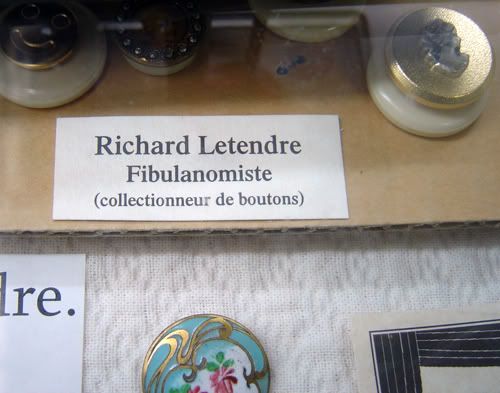
It’s a tiny shop-cum-theatre, with ribbons one on side and buttons on the other, presided over by Richard Lentendre, fibulanomiste:

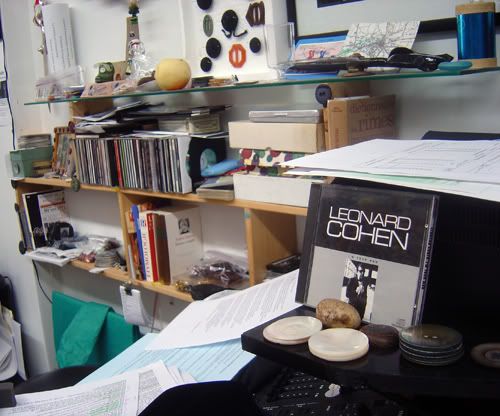
Like many tiny shops in Montreal, it’s full of an assortment of not just items for sale but interesting knickknacks and, well, stuff. Not shown are the anti-zipper posters and many, many buttons put up as decoration:

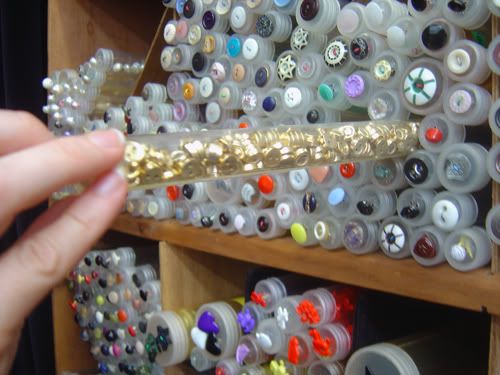
In the back of the store Mary found suitably little and tiny buttons, stored in tubes that pull out like colourful ice core samples (says the scientist):

No buttons for me, but by my next trip I’ll have finished another sewing class and will likely be in need of some…

Posted in sewing, travel | 4 Comments

Fractal spinning: an experiment

Spin-Off’s Summer 2007 issue had an article on what’s been called, among other things, fractal spinning. Multicoloured rovings/tops, while beautiful, often come out looking muddied or busy in the final yarn. I know I’m not the only one who’s been attracted by colours on the shelf only to be disappointed by the garish and unpredictable colour combinations of the resulting yarn. Fractal spinning turns these fibres into a somewhat predictable self-striping yarn, yielding a nicer-looking final product.

Fractal spinning is essentially this: take a multicoloured strip of fibre and split it in half. Spin one half as is, which makes a singles yarn with very long colour blocks. Split the second half further, into two or more strips, and spin them in succession on another bobbin. Same colours as the first singles, but with more repeats. Ply together, and marvel at the orderly stripes (some solid, some barber-poled) that result.

I decided to try this for myself. I don’t usually wear super bright colours, but I wanted obvious colour changes, so this Fleece Artist merino braid in a clown vomit rainbow colourway fit the bill.

I split the braid in half and divided the second half into three equal parts.

What I didn’t do was weigh the two halves first to make sure I’d have equal amounts of wool on each bobbin (this becomes important later).

On the bobbins, trouble begins to reveal itself. The first half of the braid wound up on the bobbin on the left. See how much less yarn is there, compared to the bobbin on the right?

When I plied the two together, I realized the second bobbin contained about 30% more yarn than the first, meaning I’d done a pretty poor job of splitting the braid in half initially. I decided to Andean ply what was left, which still gave me stripes, but not the same stripes I would’ve had if both bobbins had been equal. I was going to hopefully compete this skein, but not with that kind of mistake. It’s a nice yarn, so I may go ahead and knit something with it (something I’d only wear at Pride, I’m sure), or sell it.

Live and learn, I suppose. Time to find that gram scale.

Posted in fractal spinning, Spinning | 6 Comments

FO: Star Crossed Slouchy Beret

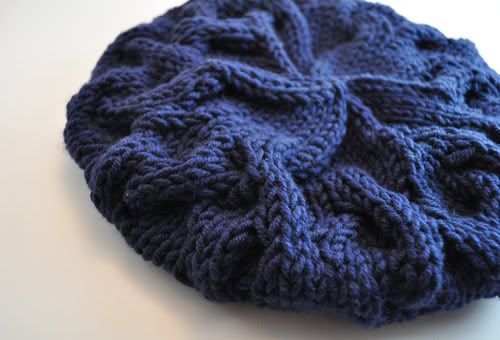
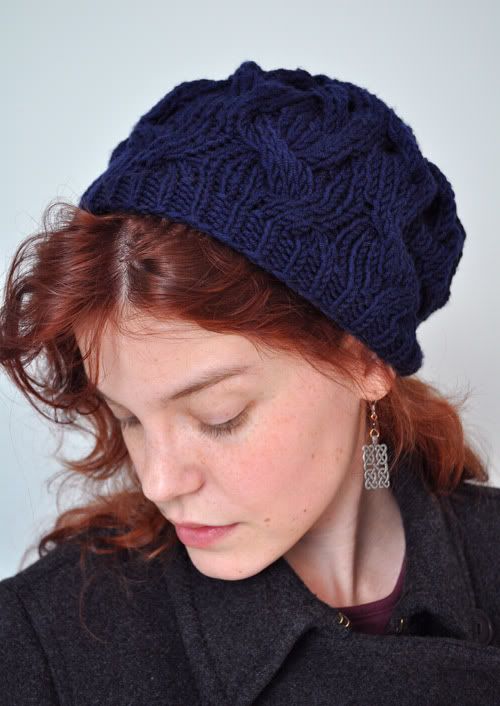
Judging by its popularity on Ravelry (6805 projects at last count), the Star Crossed Slouchy Beret is as appealing to others as it was to me. I needed a new winter hat, and the pattern looked like a quick and easy knit.

And that is basically what it was. Done over three evenings in Debbie Bliss Rialto Aran yarn (100% merino, cabled, and aran weight as the name implies), it was a straightforward pattern. I didn’t modify it at all and am very pleased with the result, though I may block it out a bit more:

It’s also warm enough that my head didn’t freeze in the -30 C temps in Montreal yesterday. It’s amazing how much warmer a light wool hat is than a thicker acrylic one.

Posted in finished object, Knitting | 6 Comments

Upcoming classes

We’ve finally found a real winter here in Ottawa, complete with snow-packed roads and -20 C temperatures. Although I enjoy the winter, I’m still looking forward to spring, including my next round of classes in Ottawa. I’ll be teaching at Wabi Sabi (such a wonderful class space), with my Beginning Drop Spindle class on March 12 and the Intermediate level two weeks later on March 26.

The beginner class is for people who’ve never spun their own yarn before. The drop spindle is an easy, affordable way to spin–much less expense than a wheel and much more portable, too. In this class, you’ll learn to spin and ply yarn on a spindle, working with both roving and top (the most common commercial fiber preparations). The cost of the class includes a spindle to take home, two types of wool, and an extensive booklet of notes.

The intermediate class is advertised as being for drop spindle, but wheel spinners are welcome as well. Sometimes people are intimidated by the word ‘intermediate,’ but there’s no need to be–if you can spin a continuous yarn, you can take this class. You’ll learn to spin woollen and worsted yarns, discover how different preparations and drafting techniques can affect the yarn you make, and try spinning batts, silk top, and raw angora or mohair. Again, all fibers are included in the cost of the class, as are detailed notes.

Interested in taking a class or have questions? Comment below!

Posted in Spinning, teaching, yarn stores | 2 Comments