wee tiny socks

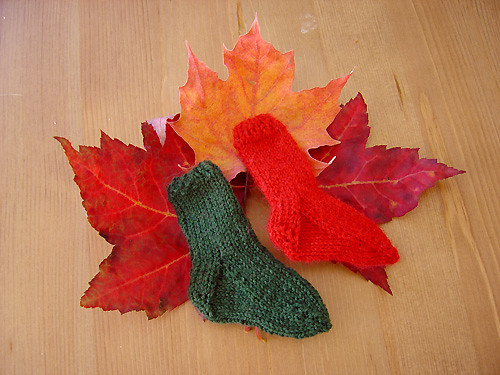
Just a brief update of some wee tiny socks I knit for a mail art swap.

I used this pattern and my smallest needles (US size 2) and the finest yarns I had: some fingering-weight unknown green stuff (the bag says “100% fibre inconnu” though the burn test points to mostly wool with some synthetic content) that was $2.49 for a huge bag at the Giant Tiger, and some laceweight Misti Alpaca. The Misti had to be triple-stranded to match the weight of the bargain green yarn, but in the end they matched pretty closely in size. I made one of each colour, resulting in Christmas colours or, as a sailing enthusiast friend of mine suggested, “port and starboard.” For the swap they’ll be attached to a postcard somehow, probably with a port/starboard theme as the background. I’ll post a picture of the finished product when it’s done.

Posted in finished object, Knitting | 5 Comments

official Blog Action Day post

For Blog Action Day, I thought I’d write a bit about why I’m moving further away from commercially-prepped roving and spinning fibre. When I started spinning my own yarn, I’d never worked with raw fleece straight off the sheep’s (or alpaca’s, or goat’s, etc.) back. As I was just trying to get the hang of coaxing a mass of unruly fibres form something that vaguely resembled yarn, the thought of washing, combing, and carding a fleece beforehand was too much.

As I’ve become a more accomplished spinner, however, I’ve also become more aware of the processes involved in turning that raw greasy fleece into roving. A few workshops with spinners like the incomparable Claire Walker taught me how handspinners traditionally process fleeces, but I’ve also learned (mostly from my own digging online and in textile publications) about how the roving you’ll find in a yarn shop (as well as all that yarn) gets made. It’s generally not a very environmentally conscious endeavour: sheep are raised in large, overcrowded lots and prophylactically treated with antibiotics and other medications (these sheep are more susceptible to diseases and parasites because of the unhealthy conditions they live in); the wool is often bought from farmers for a few pennies per pound (particularly when the sheep are primarily being raised for meat rather than wool); and the wool is treated with caustic chemicals so as to dissolve vegetable matter, eliminate lanolin, and change the natural colour.

A bit more about carbonising, which is the process whereby plant particles lodged in the wool fibres are removed: the wool is “washed” in baths of sulphuric or hydrochloric acid, which modifies the chemical bonds in the plant material. When the wool is placed into an oven and heated, the altered plant matter turns to ash which flies into the air when the wool is carded later on. The problem is that those acids are both dangerous to work with and a hazard to the environment (if they are not disposed of properly), while the airborne ash poses a potential threat to wool workers. Furthermore, carbonising process can weaken wool and make it less soft and resilient. More dangerous substances in the process come in the form of bleaches and dyes, many of which are known carcinogens.

Not a very green, or appealing picture, at least to me. And so I’ve been doing more and more of my own wool processing at home, with the following benefits in mind:

No caustic chemicals – I remove lanolin using soap and very hot water. Vegetable matter I pick out while combing or even as I’m spinning, though I’m careful only to buy fleeces that are relatively free of plant material. No carbonising agents or dyes also means the wool stays as soft and elastic as possible.

I know where my wool comes from – By choosing to buy only from small-scale, sustainably-run farms, I know the sheep that produced the wool had a good quality of life, and the environment impact is much less than if the wool had been produced in large, crowded lots.

I’m paying a fair price – Everyone likes a deal, but I like knowing that the farmers who raised the wool are getting paid decently for their work.

The beauty of natural colours – One of the things I love about wool is the array of colours that are seen right on the sheep. Bright vivid colours are nice for some things, but I’m more drawn to the creams, fawns, and charcoals produced by nature.

I can do what I want, right from the startMost commercial roving is densely packed and requires a lot of thinning and pre-drafting in order to spin a smooth, even yarn. Pre-drafting is one of my least favourite parts of spinning, and I’d rather avoid it by doing my own carding and combing to produce rolags or top that are ready to spin.

Even though it’s a lot more work, I’ve come to really enjoy preparing raw fleeces for spinning, and it’s made me become more aware about the origins of the materials I work with. Coming up will be a series of posts on just how I process wool, from raw fleece to yarn. Keep an eye out for that!

Posted in Spinning, sustainability | 4 Comments

vintage Red Cross knitting

Yesterday I ventured out into the chilly autumn rain (and forgot my umbrella) to go to a fabric flea market in the Glebe. I don’t have much need for fabric (I’m a lapsed quilter, and never learned to sew on a machine, though I’d like to change both of those at some point) but I heard there’d be some knitting-related items there and so decided to check it out. There was a lot of old and scratchy acrylic yarn in horrible 70s colours, as well as several dinged and dented pairs of aluminum needles. I was about to give up and leave when I spotted a seller with lots of old crafts magazines, and there I found this:

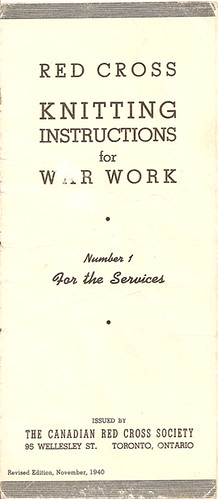
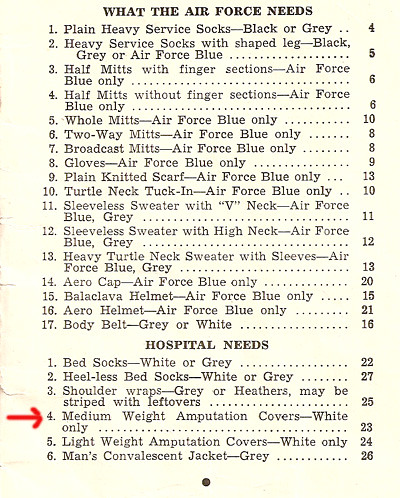
It’s an instructional booklet published by the Canadian Red Cross in 1940, for knitters who wanted to make items for soldiers. It was an original copy for only $2, so I quickly snapped it up. I love historical items like this; for a while now I’ve been toying with the idea with writing a historical piece or two for a magazine like Spin-Off or Interweave Knits. I also scored several other knitting patterns from the 40’s and 50’s, mostly sock patterns featuring photographs of men with Brillcreamed hair playing golf and generally looking wholesome. I love the Red Cross booklet, though–it’s got patterns for items needed in all branches of the service, as well as hospitals:

Note the “amputation covers”. When I first saw that I thought, thank god we’ve come a long way since WWII. And then I remembered all the soldiers coming back from Iraq missing limbs, some of them even returning for further tours in the Middle East once they’ve become accustomed to their prostheses! Further research reveals that amputation covers, or “stump socks”, are still used in fitting artificial limbs. Interesting.

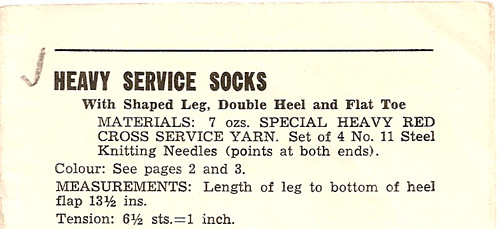
There are no pictures in the booklet, so it’ll be a surprise if I decide to knit anything from it. I’m thinking a pair of mittens, though probably not the Rifle Mitts with the separate trigger finger! Whoever picked up this little booklet back in 1940 evidently decided on socks, judging by the pencil mark:

Given how hugely popular sock knitting is right now, I imagine she (or he) would be in good company these days. I wonder if she’s still knitting?

Posted in Knitting, vintage | 1 Comment

coffee swap questionnaire

Having been sick for a week now, just about the only thing I have the energy to post is this questionnaire for the Knitter’s Coffee Swap 3 (because I clearly don’t have enough caffeine in my life already):

1. Whole bean or ground? I’m going to say whole bean, and use this as a reason to finally buy a coffee grinder.

2. Fully-loaded or decaf? Fully loaded.

3. Regular or flavored?
I’ve got strong feelings about this: I hate, hate flavoured coffee. Sometimes I’ll add chocolate to coffee, but I in general I find pre-flavoured coffees to be cloying and undrinkable.

4. How do you drink your coffee? Usually in latte form–lots of milk or cream added.


5. Favorite coffee ever?
Bridgehead, a local (just in Ottawa, though I think they’re in Montreal now as well) chain featuring all organic, fair-trade, shade-grown coffee. Their Yirgacheffe is my current favourite.

6. Are you fussy about your coffee or will any old bean do?  I admit, I’m a coffee snob.  Nothing from a can, and no Tim Horton’s!


7. Favorite treats to have with your coffee? 
Scones, or other pastries.  Mmm, butter and sugar.


8. Anything else about your coffee preferences? 
Often.  ;)


9. Yarn/fiber you love? 
Anything grown on a mammal (wool, alpaca, mohair, qiviut, etc.).


10. Yarn/fiber you hate? 
Acrylic.  I’m not hugely into plant fibres either, but I’ve been looking for some organic cotton to make mesh shopping bags with.


11. What’s on your needles? 
A mosaic-patterned purse… almost done, except for felting.


12. Favorite colors? 
Cool colours:  blue, green, grey.  Also dark rusty reds.


13. Allergies? 
Nothing likely to come up in this swap, but just in case:  I’m allergic to raw fruits, vegetables, and nuts.  Cooked/pasteurised is fine.


14. Anything you really love, really don’t like, or just need to get off your chest? 
I’m a big fan of fair-trade and shade-grown coffee.  Coffee production is something that has been very exploitative traditionally, so I like to keep fair trade and environmentally protective practices in mind when I buy my coffee.

Posted in coffee swap, Knitting | 2 Comments

renewable vs. sustainable (the Pidge, again)

You know, I hate to harp on one thing in particular (and in fact I’ve been working on a series of posts detailing the way I produce my yarns, start to finish–stay tuned for that), but I happened to look at the website for the Pidge again this morning.  They’ve done a complete overhaul, and the changes have got me thinking. Gone are the photos of their knitting studio, and each page has been redesigned to give as green and natural a look as possible. The textual information has been altered as well:

The original:

in fact, aside from the handful of halogen lights illuminating 3Fe Apparel’s knitting studio, each Pidge is created using no electricity at all.

The new version:

in fact, aside from the handful of halogen lights illuminating 3Fe Apparel’s knitting studio, each Pidge scarf is created using practically no electricity at all.

I’m guessing the word “practically” is a large enough umbrella under which to hide the TV, stereo system, and large lighting apparatus shown on the old version of the site. To drive home their claim of Amish-like rejection of electricity, one of the pages even features this rustic photo of a fire roaring in a grate.

One thing that didn’t change is this phrase: the Italian cashmere and olivewood buttons of The Pidge are renewable resources. This is all true. Cashmere, being produced by goats, is entirely renewable (unlike, say, fossil fuels, of which there is a limited supply). But is it sustainable? That is to say, can its production be supported by nature indefinitely?  I mentioned in my last post that cashmere production in China is having a devastating impact on the environment, as goats destroy vegetation (they eat all the way down to the roots, killing the plant) and tear up topsoil with their hard hooves. China’s already facing a Dust Bowl scenario comparable to that which occurred in the US in the 1930s, and the continued production of cashmere in the region is making it worse. This is certainly not a sustainable practice because if it continues, not only will the goats’ food source (vegetation) disappear, but so will millions of acres of arable farmland.

The Pidge is made using yarn from Karabella, an Italian mill that imports its raw cashmere from China. So, yes, the Pidge may be using a renewable resource, but certainly not a sustainable one, and that’s what bothers me so much about their claim of “attention both to the good of the customer–and the good of the Earth.”

Posted in Knitting, sustainability | Leave a comment

the Pidge and being “green”

Recently there’s been a bit of buzz on ravelry about a new little garment called the Pidge. Basically it’s an 1/8 of a scarf, with buttons, to be worn around the neck as a sort of collar:

The makers of the Pidge describe themselves as environmentally friendly, because aside from the Italian cashmere yarn, each Pidge is made with domestic materials and produced using no electricity, aside from the “handful of halogen lights illuminating the knitting studio.” Want one of your own? They’re only $275-$425.

I’ve been keeping my eye on the Pidge site for a couple of weeks now. For one thing, I don’t buy their “eco-friendly” line. First their claim that the Pidges are produced using no electricity aside from a handful of halogen lights. Well, as these pictures of their “atelier” show, that handful is a large overhead lighting system:

And as for the claim that there’s no other electricity involved, how about the TV, microwave, and coffee maker?

I’m going to go out on a limb here and assume they have some sort of climate control (heating, AC) as well. And there’s nothing wrong with that–I believe people should have a comfortable working environment. But it does blow a big hole in their “no electricity” claim. They’re hardly making these things by firelight in a cave.

My other bone to pick is the use of Italian cashmere. To quote the website: “Excepting its fine Italian cashmere, the elements of every individual Pidge–from each scarf’s unique fire-branded wooden buttons to its textile-cut fasteners and unique patterns–are all conceived, designed, and created domestically.” A few weeks ago they mentioned that they use Karabella yarns in making the Pidges, though that information has since been removed from their website. Karabella is an Italian yarn producer and like most Italian textile companies, they import their cashmere from central Asia (China and Mongolia). The cashmere is spun into yarn in Italy and exported to retailers around the world. So, the makers of the “environmentally friendly” Pidge are using fibre that travelled from China to Italy and finally to Connecticut–just imagine all the fuel (and electricity!) used to transport and process the primary material for the Pidge. Sure, the other elements of the Pidge (buttons and fasteners) are made domestically, but that doesn’t change the fact that probably 90% of each Pidge is imported cashmere yarn.

More about cashmere: although it’s grown on a goat, it’s usually done in such a way that it cannot be considered a sustainable resource. Most of the world’s cashmere is, as I said, produced in central Asia, where the goats are wreaking havoc on their environment: eating all the available vegetation and damaging topsoil. Asian cashmere goats are often underfed as well, since it results in production of a finer, softer fibre. There are North American farmers who are raising cashmere sustainably, but it’s harder to find and certainly not to be found in the Pidge.

However, in the end, I doubt that the people willing to shell out $400 for a fraction of a scarf are the type to be overly concerned with whether their Pidge is really “green” or not. It’s become trendy to be eco-conscious (whether genuinely so or not), and I doubt the Pidge is the only high-end garment being marketed as green despite dubious claims of sustainability. For me it’s all the more reason to research where my money’s going to, and if in doubt, I’ll knit my own 1/8 scarf.

Posted in Knitting, ravelry, sustainability | 12 Comments

knitting for babies

This has been a big year for babies among my friends. So far four have been born, with another four due between now and February. This works out well for me, since I love knitting for babies and now have plenty of kids to foist my creations on. The great thing about knitting for kids is that the projects tend to be small and therefore a convenient way to try new things (when you have to rip out an entire sleeve’s worth of knitting on your first sweater, it’s a lot less grief if that sweater is toddler-sized). It’s also an outlet for any urges you may have to knit something “cute”–assuming, of course, that your grown-up acquaintances aren’t clamouring for you to make them a pair of booties with pom-poms.

Sometimes it’s hard to decide what to knit for friends’ kids, though. Take these fruit hats. Yes, those are baby hats made to look like little strawberries, plums, etc. Pretty cute, I thought, and I planned to file them away for future projects, but then I heard a couple of parents say how creepy they are. And yeah, maybe you wouldn’t want your child’s head to look like something edible. Good point there.

A lot of people like to give silly nicknames to their unborn baby, which I find cute and funny. I actually nicknamed my co-worker’s unborn baby, and she was good-natured enough to laugh at my choice of “Cletus” rather than refuse to speak to me ever again. Anyway, this brings me to my next dilemma: is it okay to knit an item related to the in utero nickname? Most people never use the nickname again after the kid is born, and don’t want other people using it either. However, a friend of mine referred to her daughter as “the Squid” before she was born, and I was so very tempted to make her this squid hat. In the end, I knit her something else and filed away the squid pattern in case a marine biologist friend of mine ever decides to have kids.

Posted in Knitting | 7 Comments