Official Blog Action Day post: Reduce our demand for animal products

As I’ve written on this blog before, I try as often as possible to buy my yarn and fibre from local, small-scale farms. I generally try to extend this to food as well, taking advantage of farmers’ markets as well as co-ops to buy meat, milk, and fresh produce. I like knowing that not only am I supporting local family farms, but I’m also encouraging producers to raise food animals in a more natural and humane way.

Recently I went to a panel discussion at Penn on the use of antibiotics in food animals. Representatives from both sides of the issue were there and universally agreed that prophylactic antibiotic use is, in fact, increasing the incidence of antiobiotic resistance among microbes. I went into the panel venue that night thinking that antibiotics should simply never be used unless an animal is sick, but I came out with the realisation that the issue is a lot more complicated than that. The point that stuck with me the most was made by a cattle veterinarian who works for Bayer. Since Bayer manufactures many of the antibiotics routinely given to livestock, of course he was a proponent of their use, but he talked about how routine antibiotic administration is necessary to meet the current demand for meat and other animal products. His reasoning was this: there is not enough land to raise all cattle, chickens, and other livestock in a more natural/free-range setting. Therefore, we have to rely on factory farms where animals are living indoors in very close quarters in order to produce as much as consumers are demanding. In a crowded, poorly-ventilated factory farm facility, you have to use antibiotics prophylactically to prevent widespread outbreak of disease.

Now, this vet saw the logical conclusion as being we must continue to use antiobiotics in livestock in order to keep up with consumer demand for animal products. However, I came to a different conclusion: we have to reduce our demand for animal products. The only way I see to simultaneously reduce antibiotic resistance, the cruelty of factory farm husbandry methods, and environmental devastation, is to cut back on our consumption of meat and dairy. Interestingly enough, this article in the Guardian was recently published on this very subject–reducing demand for animal products is absolutely necessary to combat climate change.

I am not a vegetarian; I was one for two years and was unhealthy and miserable most of the time, though I certainly envy people who are able to live well on a meat-free diet. I consume probably more dairy than most people and eat meat almost every day, so this is not an easy recommendation for me to make, especially when the article linked above quotes four portions of meat and 1 litre of milk as the maximum intake per person per week needed to stop climate change. However, I think when it comes to our environment as well as the welfare of the animals we depend on for food, reducing consumption of animal products–even just a little–is the only way to go.
Posted in sustainability | Leave a comment

So. Vet school. Kind of takes up most of my time, but has been surprisingly conducive to knitting because of the 4-7 hours a day I spend in lecture. I used to knit during my seminars at Wellesley–I’d usually knit socks because they were small and not very distracting (although in one particular small class I started knitting under the table when I noticed everyone intently focused on my hands, rather than the professor). So far at Penn I’ve knit a sock and a half, a few pairs of booties (I’ve taken to keeping several on hand for the birth announcements that crop up every month or two now), and almost two teddy bears. I find it helps me focus on the lecture better, especially when the lecture is something as thrilling as glycolysis or the electron transport cycle. Sorry biochem fans, but that stuff is brutal.

I also found myself elected the Fiber Arts Chair of the new Small Ruminant Club at Penn. Quite a surprise to me since I didn’t even know I was nominated, but I’m happy to take on the role of organising fibre arts activities among vet students–weekly knitting gatherings, a learn to spin class, maybe a trip to an alpaca farm. I also joined as a student member of the American Association of Small Ruminant Practitioners, since that’s where I could see myself in the veterinary field someday.

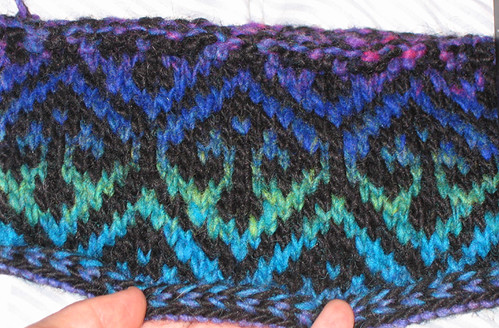
And on an unrelated note, I really like this Turkish motif adapted by Charlene Schurch. I’ve used it in several hats, the most recent one shown in progress below in Noro Kureyon and Lamb’s Pride. Unfortunately I miscalculated the number of stitiches required and it turned out huuuuuuuuge, so it’ll be frogged and redone. Probably during biochemistry this week.

Posted in Uncategorized | Leave a comment

FO: handspun polar bear

A friend of mine is moving from Montreal to Dubai, along with her husband and one-year-old daughter. For Iseult’s first birthday, I made this little polar bear as a memento of her Canadian birthplace. The pattern came from here, and I used all Canadian materials for the yarn. The body is BFL I spun, and the face was made from fleece I spun from a llama at Elisabeth’s Llama Ranch in Winchester, ON. Despite my hurried knitting during orientation at Penn, I didn’t finish in time to get it to them in Montreal so it will have to endure what is to be I’m sure a very long journey to Dubai.

Posted in Knitting, Spinning | 2 Comments

A visit to Philosophers Wool

I first discovered Philsophers Wool a few years ago, when I stumbled upon a book of their Fair Isle sweater patterns in a library in Colorado. Since then I’ve admired them for their commitment to producing local, natural, and fair trade yarns–unlike most wool buyers, Philosophers Wool pays farmers a fair price for their fleece (think a couple dollars a pound, versus a few cents from most wool buyers) and still make a profit.

Last month I was staying not far from the PW farm in Kincardine, ON, and jumped at the chance to see the farm in person. What transpired was a lovely visit, including good conversation with the owners, Ann and Eugene, a tour of the farm, and the chance to model their newest sweater designs in exchange for some yarn (look for me on the new sweater kits if you see their booth at Rhinebeck this year). The local/organic ham sandwich Ann made me for the drive back was a treat, too. Yum. Now for some photos:

A few members of the farm flock of Dorset sheep:

This chicken kept a close eye on me as I wandered near the coop:

The full palette of yarn colours, as seen in the foyer:

I also bought some roving, since I couldn’t resist the opportunity to spin some of their wool myself. It’s now spun, skeined, and waiting to be made into hats or mittens (or possibly sold as is).

Posted in Knitting, Spinning, sustainability, yarn stores | Tagged | 2 Comments

brief update

Clearly I deserve some sort of award for Blog Neglect, but the briefest of updates as to my goings-on in fibre arts these days:

– More classes at Ariadne;

– Devoting time to building an inventory to sell at Puces Pop this October (hopefully);

– Handpainted spinning fibre. By me.

With all this going on, I think I need a real website…

Posted in finished object, Knitting, Spinning, yarn stores | 1 Comment

New class! Intermediate spinning

I’m excited to say that I will be teaching an intermediate level spinning class, Spin 102, at Ariadne Knits in June. Having taught a lot of people the basics of spinning, I’m happy the lovely ladies of Ariadne are having me back for a workshop on fine-tuning your spinning skills: it’ll cover different drafting styles, working with fibres other than wool, and other skills for creating the yarns you want. There will be lots of fun fibre to play with, including carbonised bamboo and hand-blended batts.

I’ve been having such a fun time teaching my learn-to-spin classes, so it’s great to be able to offer something at the next level. There’s another workshop in the works at Ariadne too… one on working with raw fleece and fibre preparation. Look for info on that next month!

Posted in Spinning, teaching, yarn stores | Leave a comment

observations from old issues of Spin-Off

I’ve been working my way through a pile of old issues of Spin-Off magazine, courtesy of the local guild library. There are quite a few articles on teaching spinning (of particular interest to me these days) as well as some wonderful technical articles. Dense, jam-packed information; a real pleasure to have access to these. I like the current form of Spin-Off, but I’d love to see a return to more technical articles. Anyway, a few little things I’ve noticed:

– The folks who make the amazing Pat Green Carders have been using the same photographs in their ads since at least 1983;

– I know moths are the bane of every handspinner and woolworker, but the repeated advice in those early 1980s issues to store mothballs with your fleeces and yarns is really scary. I found one mention of the potential toxicity of naphthalene and p-dichlorobenzene (the chemicals in mothballs), but I think there’s good reason this recommendation doesn’t ever show up in Spin-Off today (the incidence of hemolytic anemia, especially in children, after exposure to naphthalene should be enough to dissuade any fibre artist from keeping it in their home… at least I hope so).

– Man, did people ever like spinning wool in the grease! I never spin in the grease (it gunks up my wheel, and I think you can never get the finished yarn truly clean… I even wash the dust out of my alpaca before spinning it), but I see references to it over and over. It’s something I never see in Spin-Off these days, probably because there’s so much readily available commercially-prepared fibre out there. And maybe people just realised it’s much more pleasant spinning clean fleece (at least in my opinion).

– Qiviut! For only $20/ounce! Well, back in 1983…

Posted in Spinning, vintage | Leave a comment